
Workshop Journal · Cooling Havens
Kossuth Square – observations on site and a development proposal from the Cooling Havens site visit
The climate adaptation potential of an urban park can rarely be captured by a single eye-catching intervention. Heat, the condition of vegetation, the path water takes, irrigation, surfaces, patterns of use and maintenance form an interconnected system. A site can only become genuinely more resilient to more extreme summers if these relationships are examined not as separate problems but as parts of a single, shared way of working.
The walkabout on Kossuth Square during the Cooling Havens site visit to Budapest made this approach tangible.
The professional discussion in the field was not about presenting a finished plan. It was much more about exploring what opportunities the square's current features offer for a later, more comprehensive climate adaptation renewal. Participants looked at the existing green space, the movement of water, the tree stock, irrigation, the resting and play functions, and the relationship between the park and its surroundings, all at the same time.
An important principle emerged from this on-site thinking. The development potential of Kossuth Square does not necessarily lie in adding new elements. Rethinking how the existing elements work together may be at least as important.
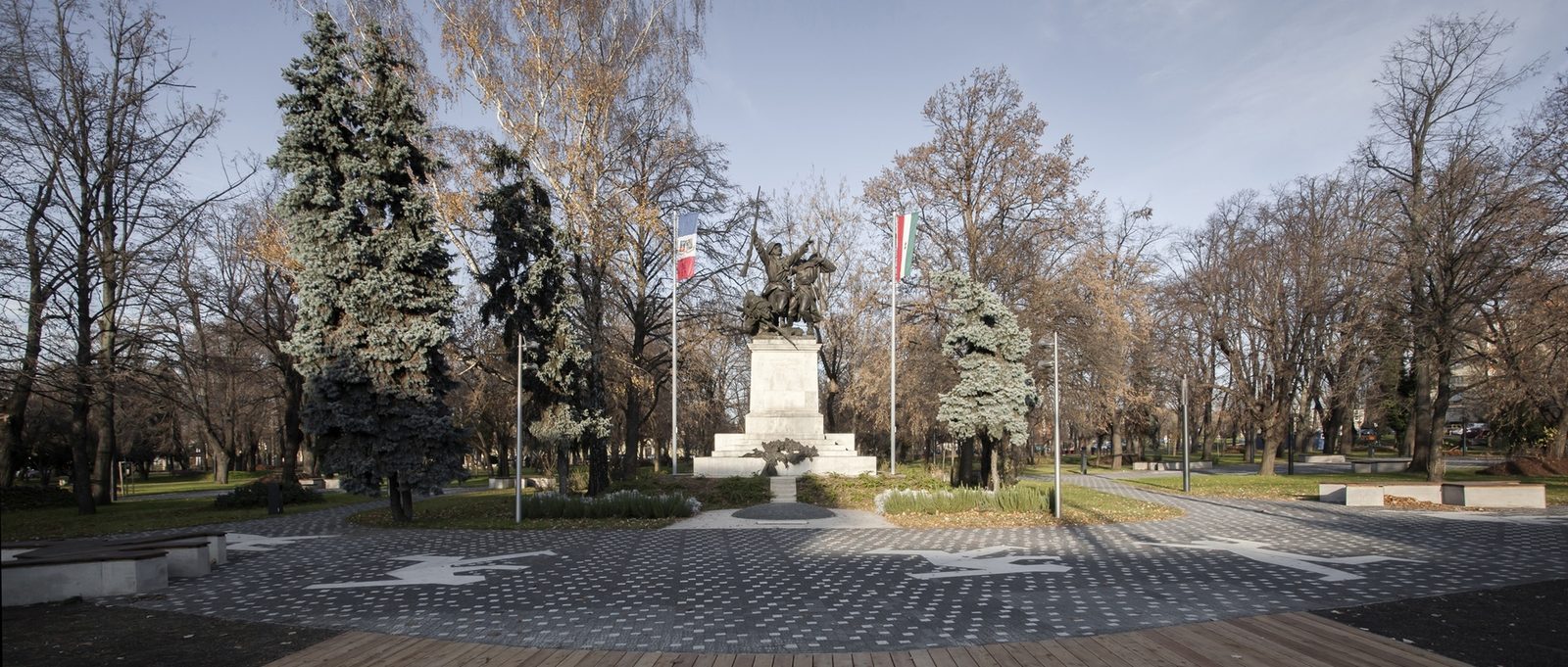
The starting point: not every existing element works as it was designed to
One important focus of the site investigation was how the square functions day to day.
According to the professional notes, the current benches do not always work well from a functional point of view, and they are difficult to maintain. At first sight this may seem a minor design issue, but in fact it illustrates well one of the fundamental dilemmas of public-space development.
The usability of a park is not determined solely by the size of its green space or the number of built elements. It also matters whether these elements actually support everyday use, whether they are comfortable and maintainable, and whether they can be kept in good condition over a longer period.
This is especially important from the Cooling Havens perspective. A climate-adapted public space is not simply a cooler area. It has to be a place where the cooler microclimate can actually be used. That requires shade, seating, good spatial connections and a design that works not only at the moment of investment but years later too.
Maintenance is therefore not the last question in the design process. It needs to be there from the moment the concept is shaped.
Micro-topography can be more than a simple landscaping element
One of the most interesting ideas raised in the on-site discussion was the deliberate use of small green mounds and micro-topography.
The professional view was that, if well placed, small level differences in the square do more than shape the park visually. They can influence the microclimate and alter the path of rainwater as well.
This marks an important shift in thinking.
Conventional urban drainage often aims to carry rainwater away from paved and green surfaces as quickly as possible. Climate adaptation, by contrast, increasingly looks at how rainfall can be held, slowed, infiltrated and later used close to where it falls.
On Kossuth Square, it may therefore be worth examining the question of micro-topography together with the water balance of the whole site.
With small landforms and lower-lying green areas, it is possible to influence where water flows during heavy rain, where it slows down, where it can soak in, and which planted areas can receive more of it.
Within this system, a rain garden is a particularly interesting option.
A rain garden is not just a sunken flower bed. It is a planted area that can temporarily take in rainwater running off its surroundings. Here, water does not go straight into the sewer network: part of it soaks into the ground, and part becomes available to the plants.
The idea raised on site is therefore not about creating a single mound or a single rain garden. The more interesting question is what role the shaping of the surface across the whole of Kossuth Square could play in keeping water on site.
Rainwater is best seen as a local resource
One of the clearest professional directions in the site notes is the on-site use of rainwater.
This matters for urban climate adaptation in two ways.
On the one hand, periods when large amounts of rain fall in a short time may become more frequent. Rapid drainage can then put serious strain on urban drainage systems.
On the other hand, the same year may also bring longer hot, dry spells. The park's vegetation then suffers from a shortage of precisely the water that arrived in excessive quantities a few weeks or months earlier.
Linking the two problems offers a logical way forward.
If some of the rainfall can be kept on site, infiltrated or suitably stored, rapid runoff can be reduced, while the water can later help supply the vegetation.
For Kossuth Square, then, the question is not simply how to drain water away after heavy rain. It is at least as important to ask how this water could become part of the way the park works.
For that, however, the movement of water across the whole site has to be understood.
Where does the water come from? Where does it collect? In which direction does it flow on? Which surfaces are suitable for infiltration? Where is there vegetation that could make use of it? How much water can be handled safely on the site?
These questions will need to be answered by design and engineering studies.
Renewing the tree stock is not a single planting decision
The condition of the tree stock is also decisive for the park's long-term climate adaptation.
Based on what was said on site, renewal and rejuvenation of the tree stock will need to be planned for in the longer term.
Such a process, however, calls for particular care.
The importance of urban trees for climate adaptation can hardly be overstated. They provide shade and evapotranspiration, limit the heating of paved surfaces, offer habitat, and play a major role in how usable a park remains in summer.
At the same time, a mature tree may have a canopy and shading capacity that a newly planted tree can only approach after many years.
Renewal therefore does not necessarily mean simple replacement.
It requires an assessment of the condition of the existing stock, an understanding of the expected lifespan of individual trees, and a phasing plan that avoids, as far as possible, a sudden drop in shading capacity.
The question is also linked to water management.
New planting can only be sustainable in the long term if the species chosen are suited to the conditions of the site and can be maintained with the water available.
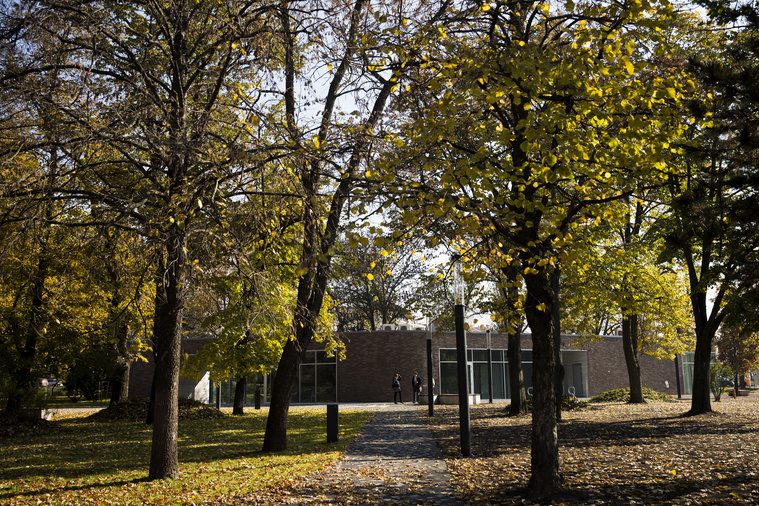
Rethinking how the water feature relates to the space around it
The walkabout was not only about the ecological role of water.
Participants also identified further opportunities for using the space around the existing water feature.
According to the notes, it would be worth examining how this area could be more closely connected with the nearby school and the play area. The question was also raised whether rethinking part of the current car park could create a better link between these functions.
This idea goes beyond water management in the narrow sense.
A water-related element in public space can be a microclimatic, recreational and space-organising tool all at once. Its effect therefore depends heavily on its surroundings, how it can be reached, where seating is placed next to it, and what other uses are connected to it.
If a water surface or other water feature is physically close to a school or playground but the layout of the space still separates them, geographical proximity alone does not create a functional connection.
At this point, climate adaptation and the usability of public space meet directly.
A cooler microclimate becomes socially valuable when people actually get there, can sit down and spend time in the space, and when the place is connected to the everyday functions that generate use anyway.
Irrigation is really a question about how the whole park works
One of the most important issues raised in relation to Kossuth Square was rethinking irrigation practice.
The starting point seems simple at first.
Is every current lawn area needed? Is it justified to water all of the grass regularly? Could there be areas where more ecological planting, longer grass or another planting structure with lower water demand is introduced?
These, however, are not purely horticultural questions.
Short-mown, intensively maintained lawn involves a particular logic of use and maintenance. It may need regular mowing and, at certain times, a substantial water supply. A different kind of planted surface, by contrast, may offer different ecological and amenity value.
The right answer may not be the same for every part of the site.
In heavily used parts of the park it may make sense to keep lawn where people can play, sit or hold community events. Elsewhere, however, taller vegetation, a more varied species mix or less intensive management might deliver greater ecological value with lower maintenance demands.
The on-site discussion also raised the question of whether certain lawn areas really need to be kept green throughout the summer at all costs.
This may seem an unusual idea at first, yet it points to an important professional dilemma.
In a dry summer, not every planted surface necessarily has to behave in the same way. In some areas, a temporary die-back of vegetation may be acceptable if the plants are able to recover later, thereby avoiding significant water use.
Such a decision naturally requires a precise understanding of the park's patterns of use and its plant stock.
Alternative water sources can also be explored
In connection with irrigation, the possible use of greywater was also raised.
This is not yet a finished project proposal, but a line of enquiry.
To make an informed decision on the feasibility of such a system, it would be necessary to clarify the possible water source, the quantity available, how it would be stored and treated, the needs of the vegetation, health and technical requirements, and who would be responsible for operating it.
The significance of the idea, however, goes beyond a specific technical solution.
Behind the question lies the idea that drinking water is not necessarily the only source that can be considered for maintaining urban green space.
Looking at rainwater, alternative water sources of suitable quality and planting with lower water demand together could make the park's water balance more resilient in the longer term.
It is better to think of one water system rather than separate elements
The ideas raised during the Kossuth Square walkabout become truly interesting when they are not seen as a list of separate projects.
Micro-topography shapes the path water takes.
Rain gardens may be able to take in rainfall temporarily.
Trees and other plants use the water available in the soil, provide shade and release moisture through evapotranspiration.
The choice of vegetation type determines irrigation needs.
And irrigation needs, in turn, affect how important rainwater retained on site or another alternative water source becomes.
In this system, the shaping of the park's surface, its vegetation, its water supply and its everyday use are different sides of the same problem.
This is exactly why one of the most important tasks in the next planning phase may be to bring these elements together in a shared water management concept.
The question is not whether there should be a rain garden.
The question is what should happen to the water that falls on the park.
The question is not whether to plant new trees.
The question is what kind of tree stock can provide adequate shade in the long term under the site's climatic and water supply conditions.
And the question is not simply how much to irrigate.
It is what vegetation can reasonably be sustained, from which water source, at what intensity and with what maintenance capacity.
The Cooling Havens link: a cooler urban space is a system-level question
The Kossuth Square walkabout connects directly with Cooling Havens thinking at several points.
A central question of the project is how to respond to urban heat stress in ways that draw on vegetation, water, public-space infrastructure and users' needs all at once.
The experience from Athens shared during the Budapest site visit also emphasised keeping rainfall on site and exploring how to create green and blue infrastructure that can adapt to more extreme weather conditions.
From this point of view, Kossuth Square is an interesting local testing ground.
Here there is no empty site for which a new system has to be designed. Existing vegetation, patterns of use, a water feature, resting functions and transport connections already operate side by side.
This is why the task may be, above all, to rethink the relationships between them.
Where is shade lacking?
Where is it worth holding back water?
Which planted area needs what kind of maintenance regime?
What spatial design could improve both the microclimate and usability at once?
How can water-related elements be better connected to everyday use?
And how can all this be designed so that operation remains realistic in the long term?
Where things stand: professional directions, not a final plan
It is important to distinguish between the possibilities identified on site and an approved development programme.
Based on the documentation available, the ideas for Kossuth Square should currently be seen as professional suggestions and development directions worth investigating further.
The next step, therefore, is not necessarily immediate implementation.
First, more precise site data is needed.
It would be useful to understand how rainwater moves across the site, the infiltration capacity of the soil, the current water demand for irrigation, the condition of the tree stock, the maintenance costs of the different planted areas and the spatial patterns of how the park is used.
If keeping water on site is an important goal, it must also be examined how much water can be safely handled on the site.
If a rain garden or other surface water retention solution is considered, its appropriate location, size and planting need to be known.
If gradual renewal of the tree stock is needed, a long-term phasing plan may be required that does not suddenly reduce the shade in the park.
And if the use of alternative irrigation water comes onto the agenda, its technical and operational conditions will need to be examined separately.
It is equally important to understand how the park is used.
Reshaping the connection between the water feature, the school and the play area, for example, can only be properly assessed if we know the current walking routes, the directions from which people arrive, how the car park is used and the daily load on each area.
What comes after the site walk?
The Kossuth Square site walk did not produce a finished plan, but questions. This is exactly what makes it a valuable starting point: before any intervention is decided, a clearer picture is needed in three areas.
The first is water. We need to know where it comes from, where it collects, where it can infiltrate, and how much can be managed safely on the site. This decides whether shaping the microtopography and a rain garden make sense.
The second is vegetation. The condition of the tree stock has to be examined, and a schedule found that does not suddenly reduce the shade in the park. This also includes which lawn areas need regular irrigation and which can tolerate management with lower water demand. Using greywater is, for now, only a direction for investigation.
The third is use. The relationship between the water feature, the school and the play area can only be assessed if we know today's walking routes, arrival directions, the use of the car park and the daily load on each area.
For the Living Lab, these three sets of questions define the next phase of investigation. If you know the square, we would welcome your experience: where is shade missing, and where does water remain after rain?
Related materials
Would you like to work with us?
Research, methodological support and solutions tested in real-world settings – for local authorities, institutions and researchers.