
Workshop Journal · Cooling Havens
What do we base our choices on? Weighing up climate adaptation solutions for Havanna
In an urban climate adaptation project, the hardest question is usually not whether we can find possible solutions. The professional toolkit is now very broad. More vegetation, more shade, smarter irrigation, rainwater retention, environmental monitoring and targeted cooling solutions can all help make a public space more liveable in summer. The real decision, however, is not about picking the most eye-catching or technologically advanced of these. The question is which intervention can bring about a genuine improvement in a specific place, given specific patterns of use and operating conditions.
In the Cooling Havens preparations for Havanna, weighing up solutions therefore does not start with comparing technologies, but with understanding the site itself.
According to the development documents for the Havanna housing estate, summer heat stress is not a standalone problem. It is linked to the use of public spaces, the condition of green and blue infrastructure, transport and parking. Large sealed surfaces and dense development intensify heating, while some of the green spaces are ageing, much of the rainwater runs off quickly, and the ways public spaces can be used do not everywhere keep pace with today's needs. The aim of local development therefore cannot be to tackle a single problem in isolation.
The area between numbers 64 and 75 shows this situation particularly well on a small scale. The earlier planning process identified poor-quality paving, little or poorly maintained green space, areas used in a disorderly way and few sports, resting and community functions that genuinely work. At the same time, the situation analysis also revealed assets worth building on: the existing trees, the larger, usable open space, the current mound, and the opportunity for the area to accommodate several types of use.
This is an important starting point. When choosing local solutions, we need to see not only what the site lacks, but also what already works, what is worth preserving, and which features can be given a new role.
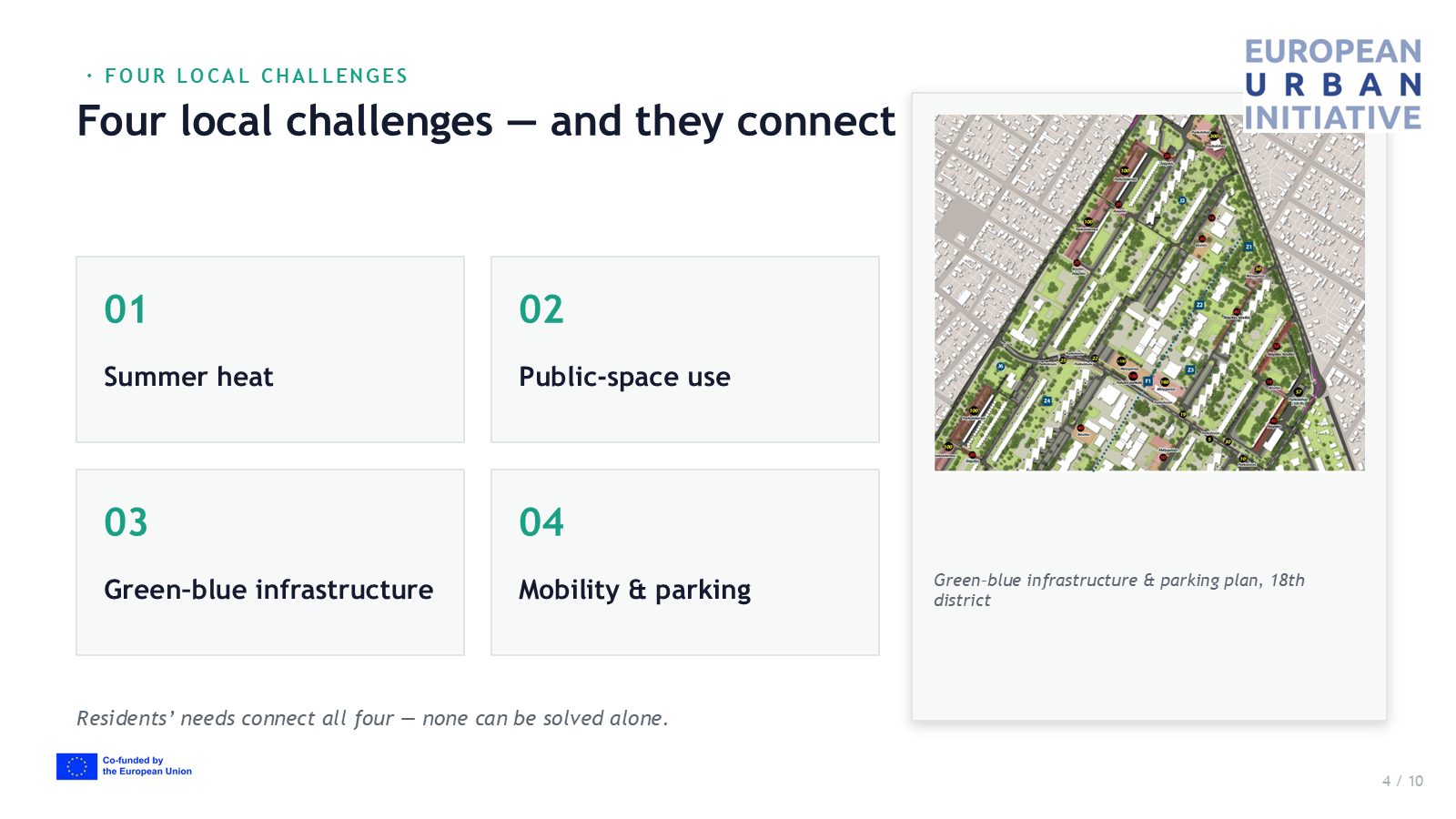
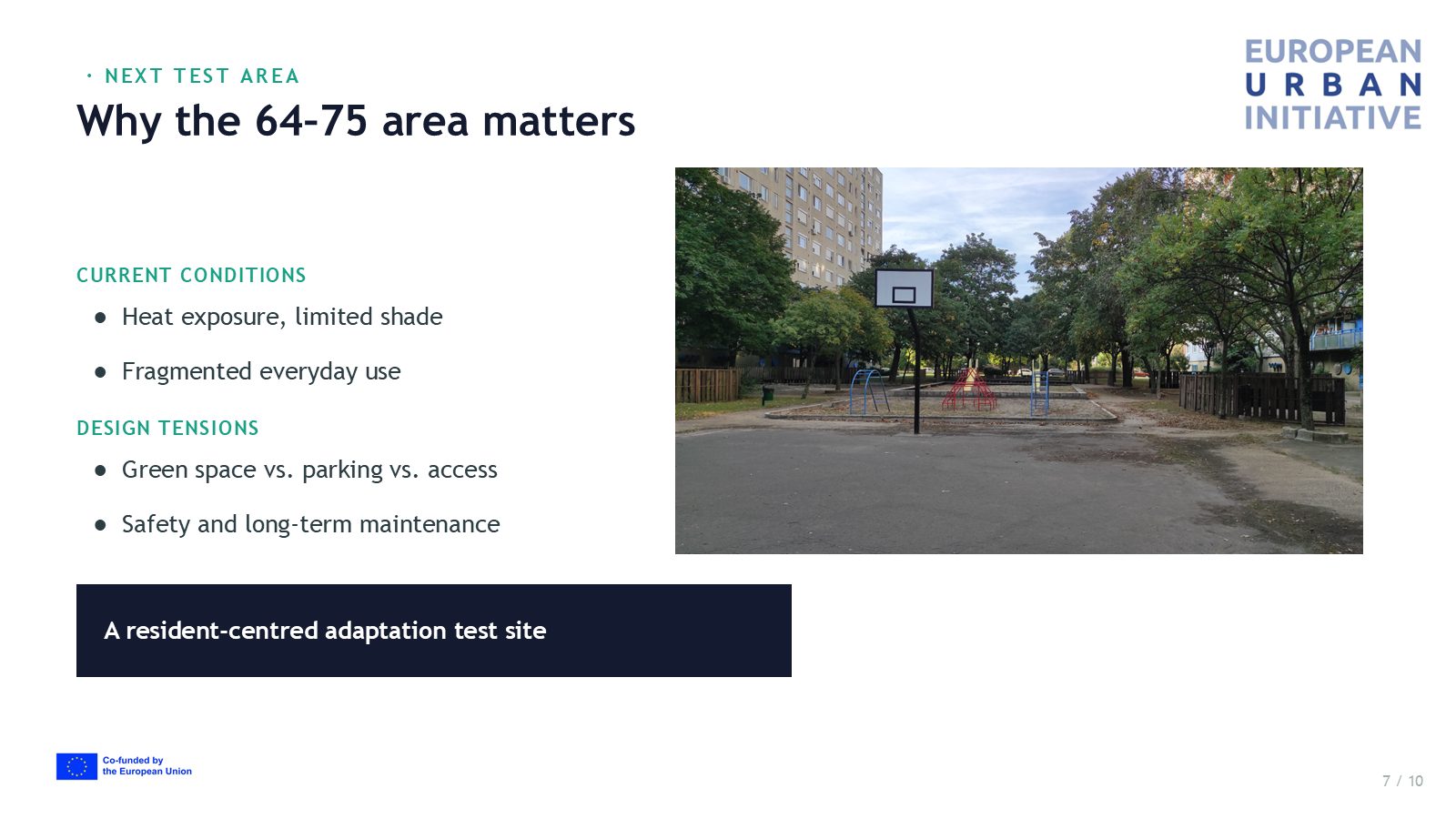
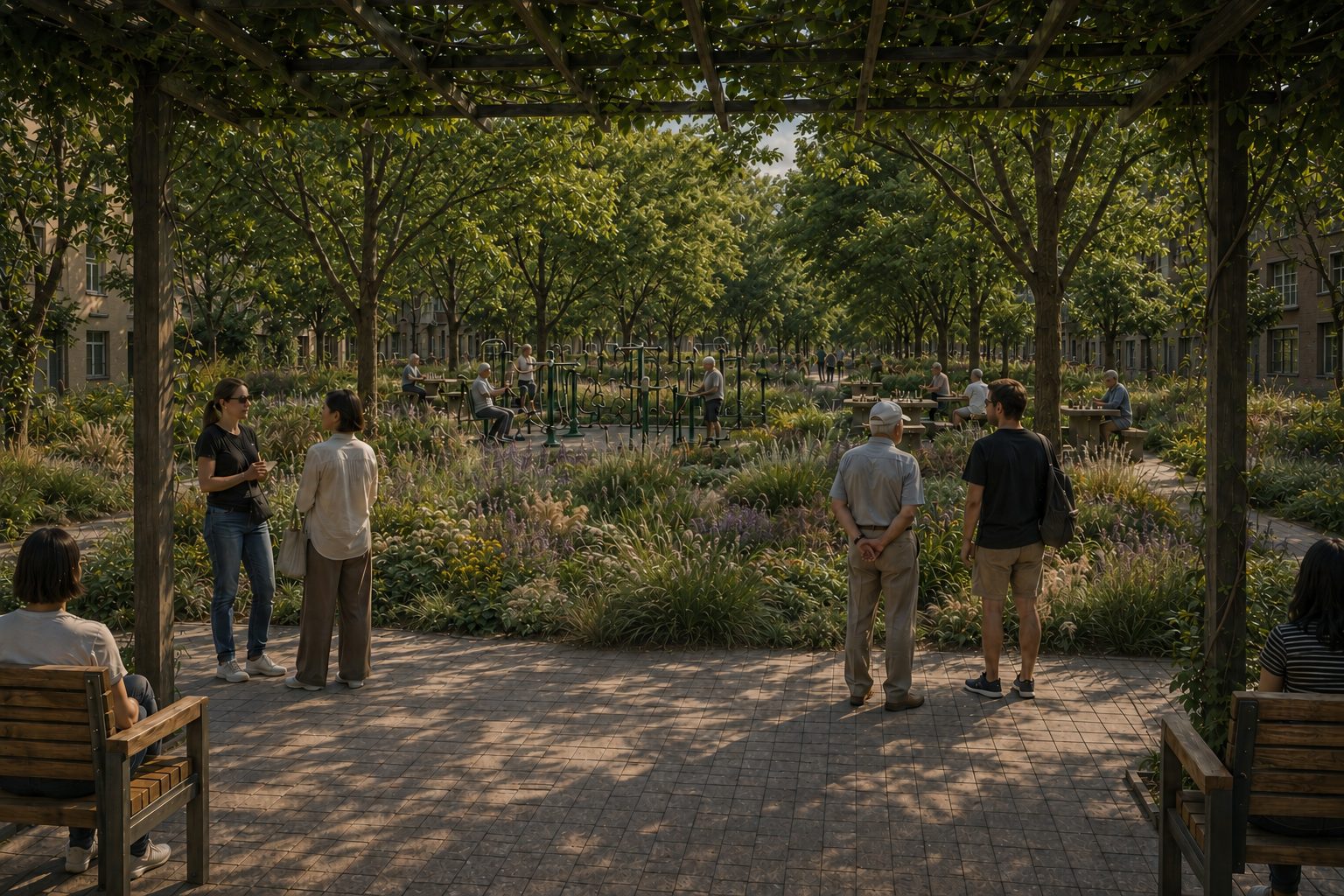
Participatory planning had already outlined the kind of change residents consider desirable. The plans included enriching the green spaces, opportunities for sport and exercise for older people, chess, quieter relaxation, a small play function and a community space suitable for meeting. This means that Cooling Havens is not placing an entirely new programme on the site. The climate adaptation solutions have to build on a local vision that has already taken shape.
The decision question is therefore much more precise than which climate adaptation technology would suit Havanna. What needs to be examined is how the development direction already chosen can be made cooler, shadier, more water-conscious and more sustainable in the long term, without losing the functions that make people want to spend time there in the first place.
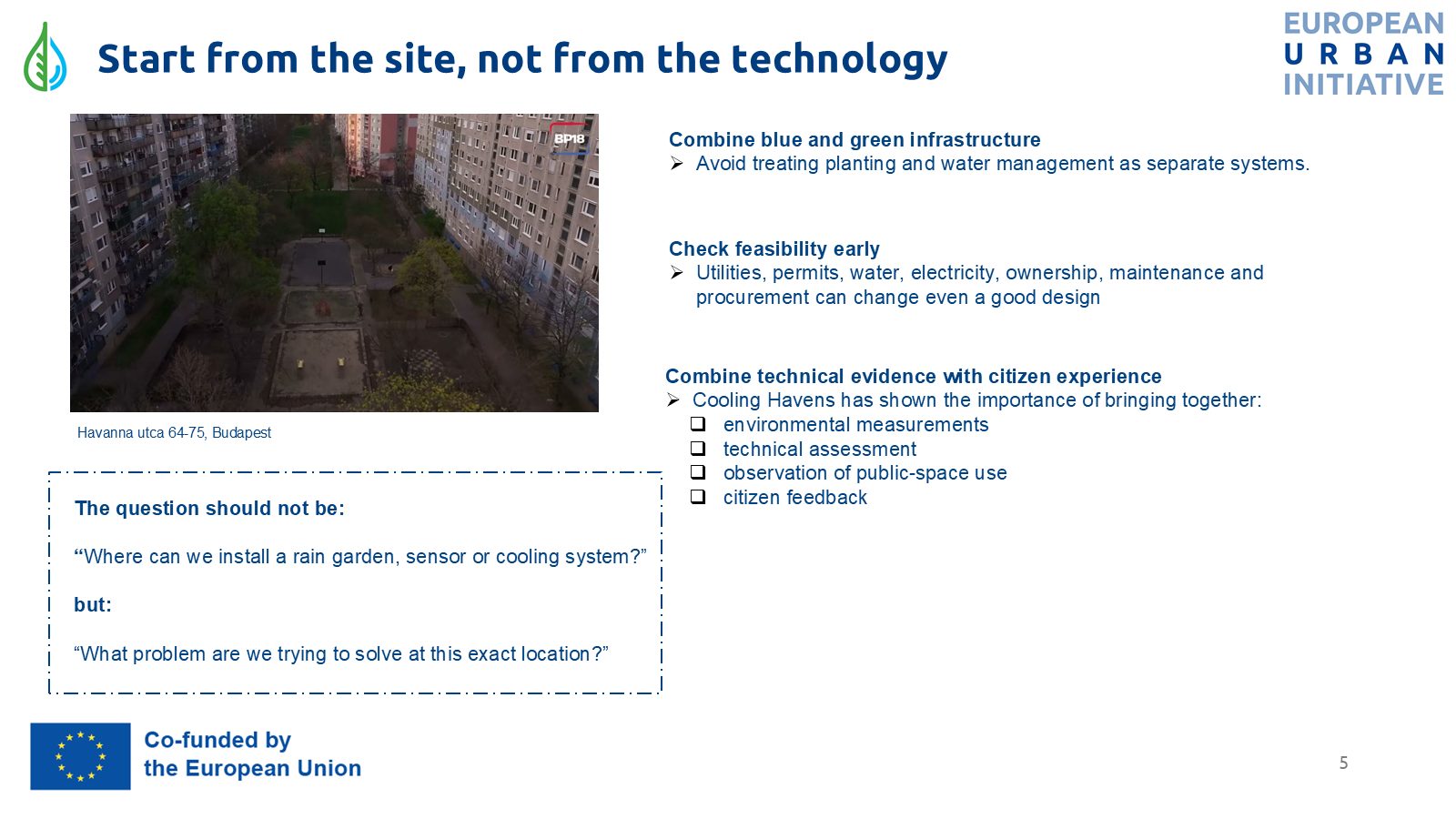
This is exactly where the experience from Athens becomes truly useful. Not because it provides a ready-made recipe, but because it shows how to weigh up the options. One of the key messages from the Athens project management at the Budapest site visit was that we must start from the site, not from the technology. A rain garden, a sensor or an active cooling system is not a goal in itself. First we need to understand what problem we want to solve at a given point, and then find the tool that can actually work given the characteristics of the place.
This also matters because a solution that looks good at first sight can easily fail on conditions that are less visible in the early stages of a concept. Underground utilities, access to water or electricity, ownership and responsibility arrangements, permitting, procurement and maintenance can all significantly reshape an original idea. The Athens experience therefore highlighted that technical feasibility, social acceptance, administrative conditions, financial realism and operability need to be examined together from the very start of planning.
This way of thinking also changes what we mean by a good solution. The best choice is not necessarily the one that promises the strongest effect under laboratory or theoretical conditions. It is rather the one whose expected benefit is proportionate to the burden of installation, operation and maintenance.
A tree, for example, does not deliver its full shading and microclimatic effect straight away. It only becomes truly significant over years, while it needs water and care in the period after planting. An active cooling system may bring a more immediately noticeable improvement in comfort, but it may require a water supply, energy, maintenance and regular operation. The decision is therefore not simply a comparison of the effects of two technologies. The time horizon, operational responsibility, expected lifespan and total maintenance demand are just as much part of the assessment.
The same applies to the relationship between vegetation and irrigation. The longer-term development approach for Havanna does not simply aim to create more green space, but planting that will remain viable under changing climatic conditions. Preserving existing healthy trees, urban-tolerant planting, biodiversity and keeping rainwater on site are all parts of the same system.
That is why decisions about greening cannot be made independently of the question of water either. If a planting scheme brings a high irrigation demand while the water needed is not available in the long term, a solution that initially seemed favourable may later become a maintenance problem. If, however, plant selection, soil, keeping rainfall on site and irrigation can be aligned, the same intervention can both improve the microclimate and reduce operational vulnerability.
User considerations add further nuance to the same decision-making process. On the Havanna estate, rest, passing through, sport, exercise for older people, play and community use all meet in the same relatively compact area. A new element is therefore not placed in a vacuum. It may affect other functions, change routes, take up space that is used differently today, or bring new groups of users into the space.
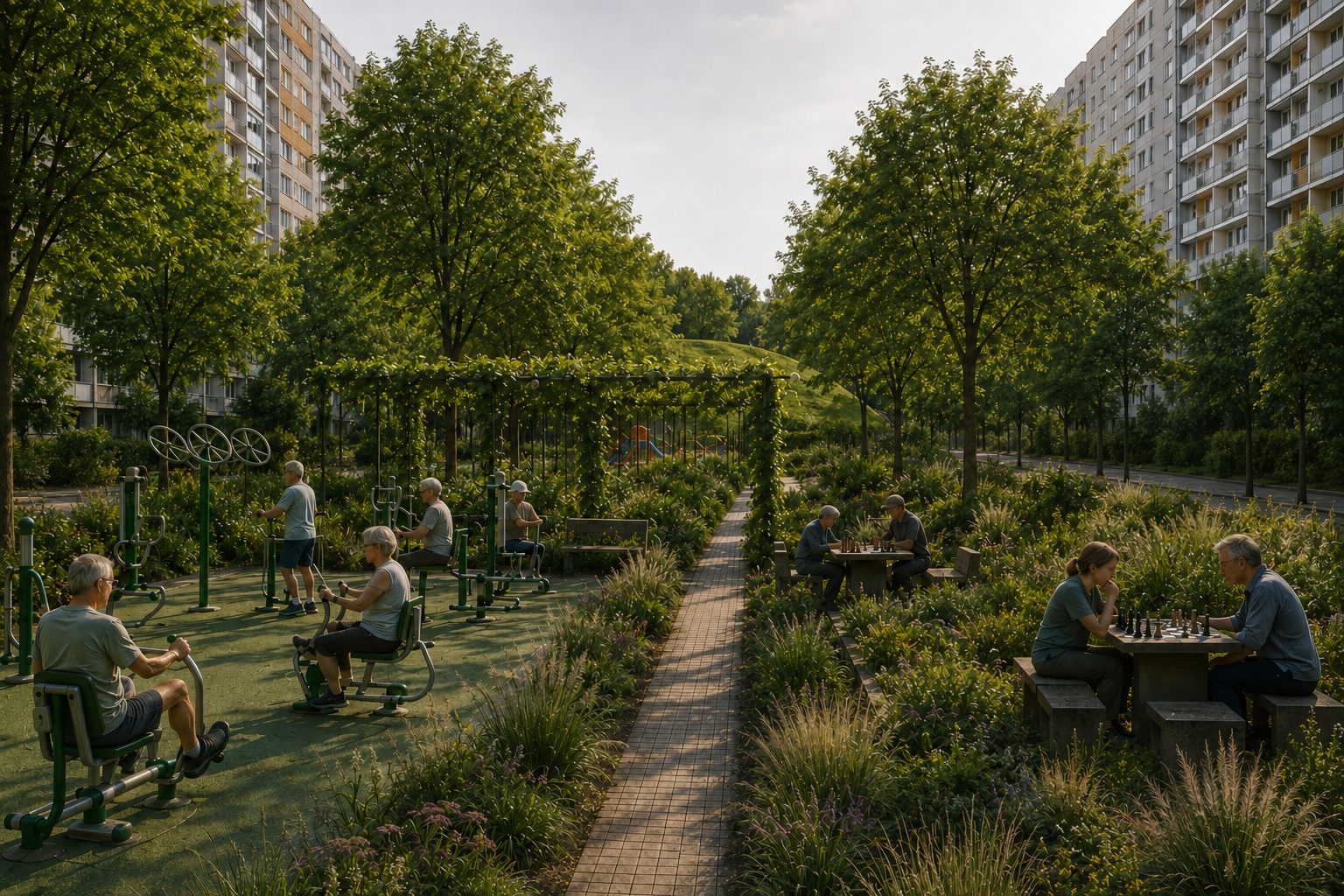
At this stage, therefore, participatory work is no longer simply about which solution people like. For residents' experience to genuinely support decision-making, the consequences of the different options also have to be made clear. More vegetation can mean more shade, but it also needs space. A water retention area can bring ecological and microclimatic benefits while changing how part of the space is used. A new sports facility can increase activity, but may take space away from other functions. And a smart system is a credible choice only if there is a clear picture of how it will be operated.
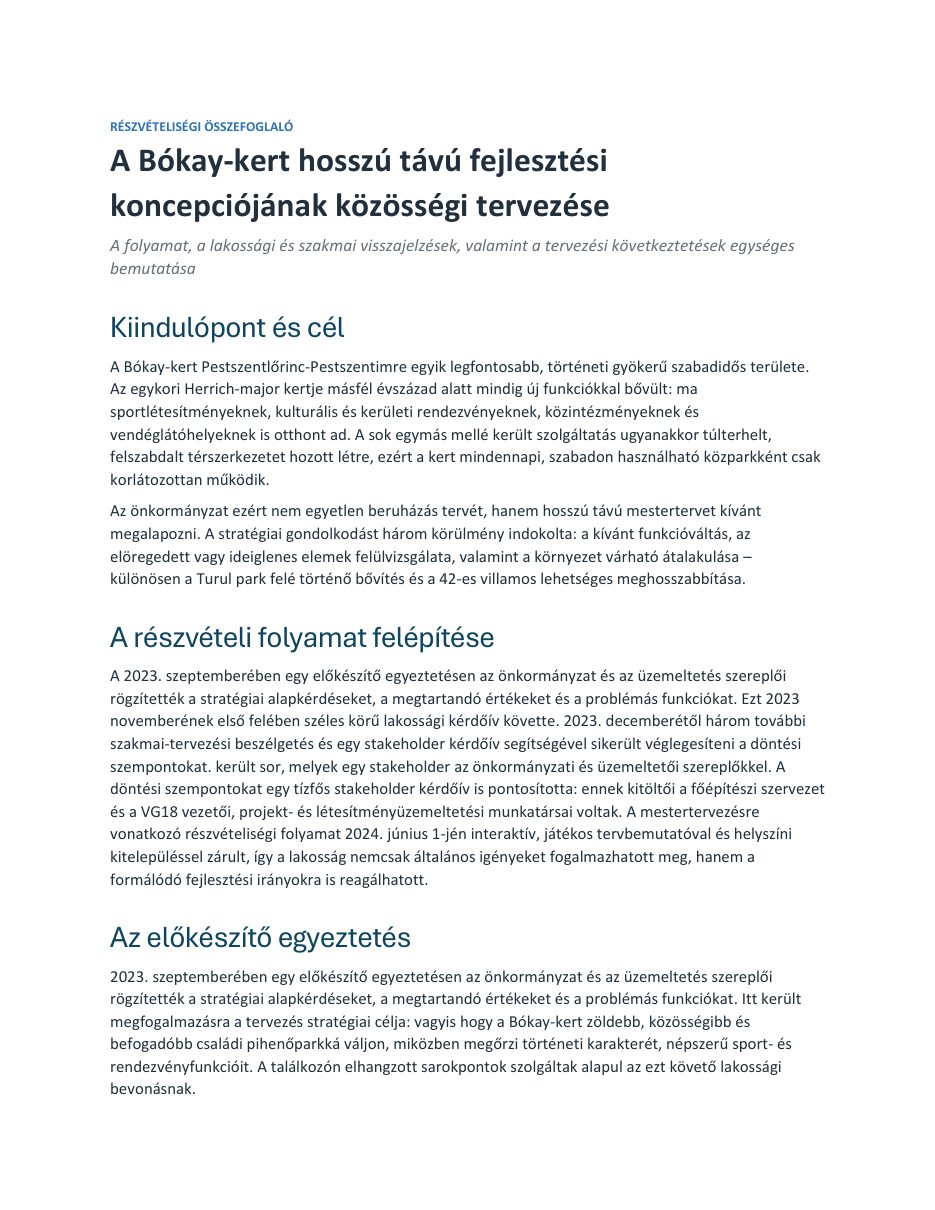
The participatory process for Bókay Garden made the same problem visible at another site. Residents' feedback did not translate directly into a plan. The wide-ranging needs assessment was followed by professional and operator consultation, in which the space requirements, sustainability, interrelationships and long-term role of each function had to be weighed up. By the end of the process, what emerged was not a simple wish list but an order of design priorities.
For Havanna, one of the workshops at the Cooling Havens site visit in Budapest showed in concrete terms how this weighing-up works. The international participants were given the same site and the same set of possible interventions, yet they did not arrive at the same ranking.
One working group put environmental monitoring first, on the grounds that without a proper picture of the situation it is hard to decide where and what kind of intervention is actually needed. Another group saw safe and accessible infrastructure as the top priority, regarding the basic usability of the space as a precondition without which cooling and greening solutions will not deliver the desired results either. Other participants ranked smart irrigation and shading higher, and already linked their choice to questions of water source, the condition of the vegetation and possible sensor locations.
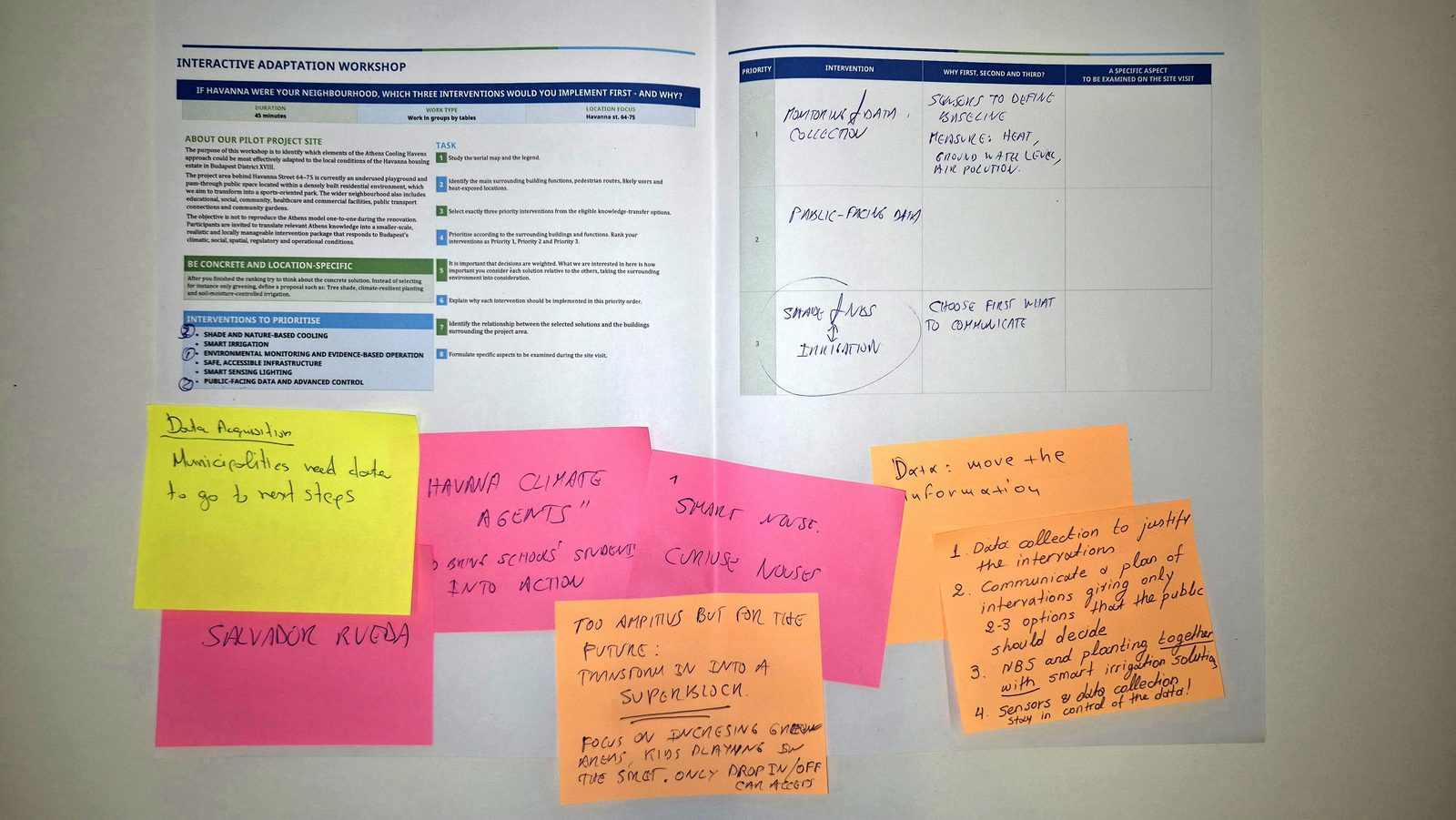
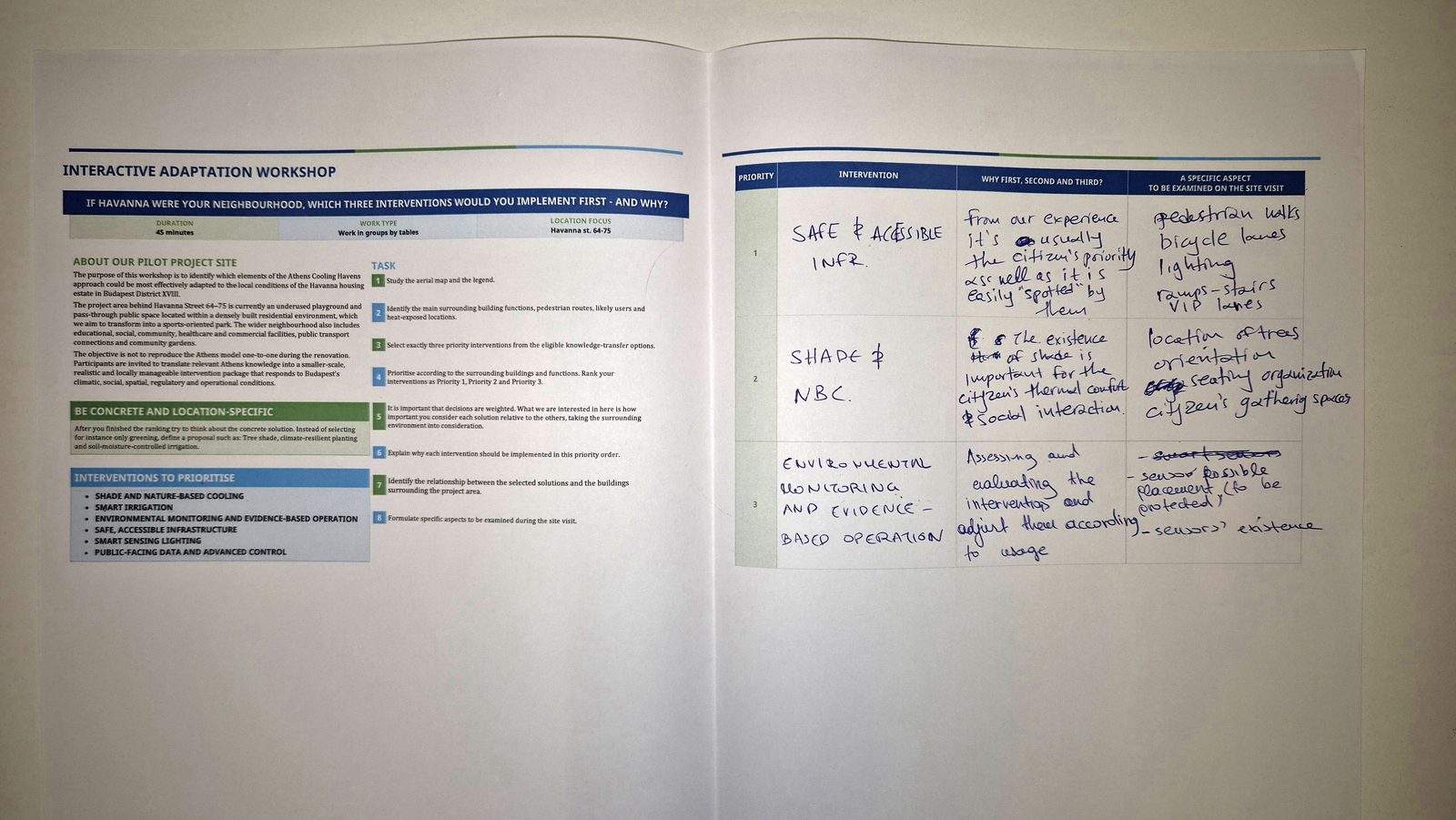
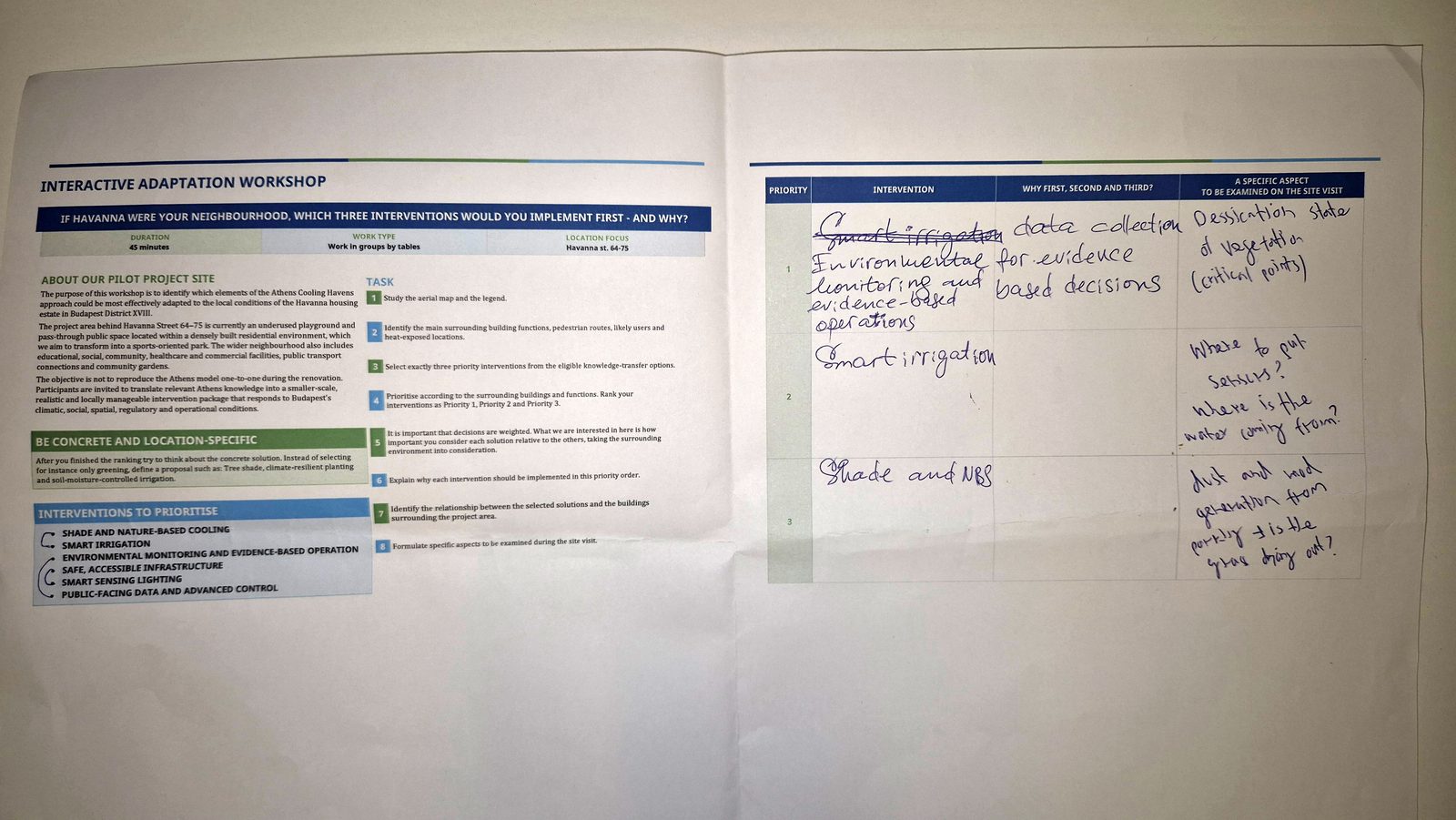
The value of the workshop lay precisely in the fact that it did not produce a single universal ranking. It did not turn out that shading, monitoring or smart irrigation would be the most important in all circumstances. Instead, it became clear that the same site can be interpreted according to several professional logics.
This does not weaken the decision; it sharpens it.
If, for example, we do not know where heat stress is greatest, it may make sense to start measuring early. If accessibility or safety is hindering use, more shade on its own may not have a significant social impact. And if the survival of new planting is the critical question, water supply and irrigation may become a primary consideration from the very start of planning.
In reality, then, the workshop did not rank technologies; it made different decision-making logics visible.
The next question was which of the professionally attractive solutions could be carried through to implementation. The World Café work therefore looked separately at the legal, technical, financial and social conditions that determine how realistic a choice is. Alongside clarifying utilities and ownership, water supply, permitting, capital and operating costs, and communication with residents also came up. Here, the decision was no longer about whether an intervention is professionally desirable, but whether it is feasible and sustainable in the long term.
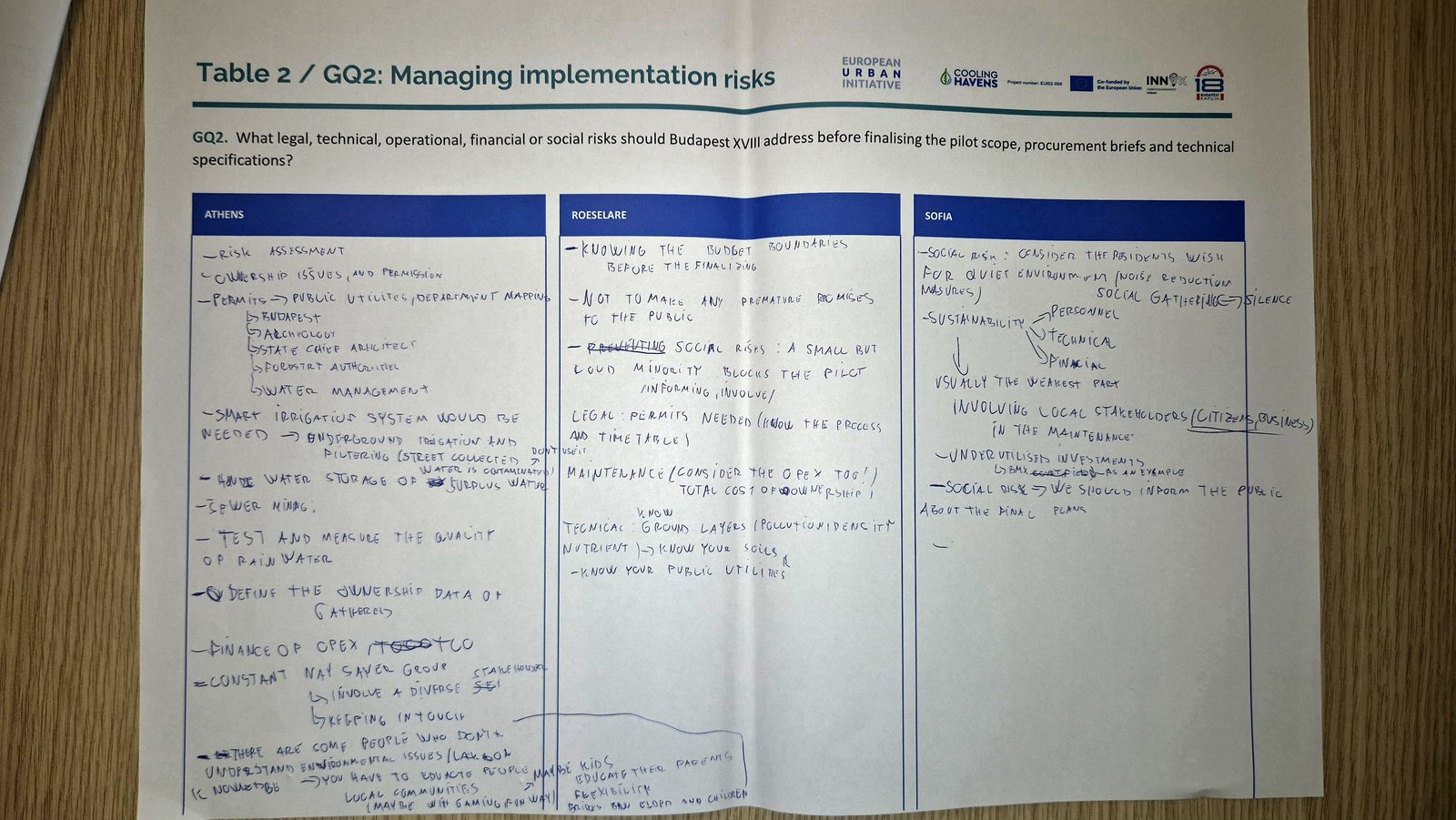
This is the point at which maintenance becomes especially important. In the short term, an investment can be completed even if the conditions for its later operation have not yet been fully clarified. With climate adaptation interventions, however, it is precisely long-term operation that determines whether they really create value.
New trees need years of care. A smart irrigation system can only improve water use if someone checks, adjusts and repairs it. Outdoor sensors need to be cleaned, calibrated and replaced when necessary. And with an active cooling solution, operating routines need to be planned alongside water and energy.
The monitoring experience from Athens supports the same conclusion. According to the professional recommendations prepared for Havanna, maintenance, calibration, winter operation, the supply of spare parts and fault handling must be clarified when designing the measurement system, before procurement. The measurement system should not include as many devices as possible, but only those that genuinely answer the most important local questions.
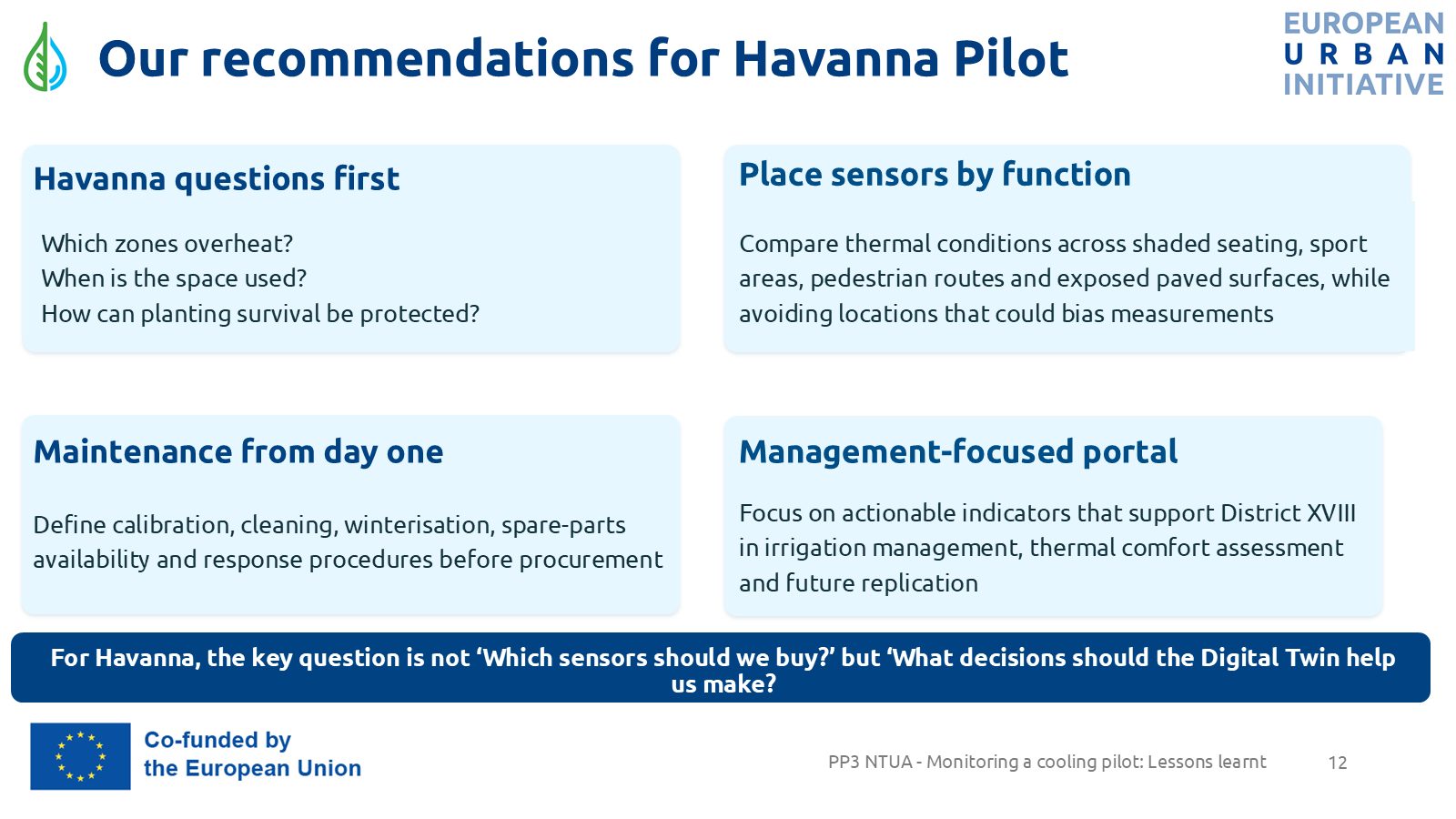
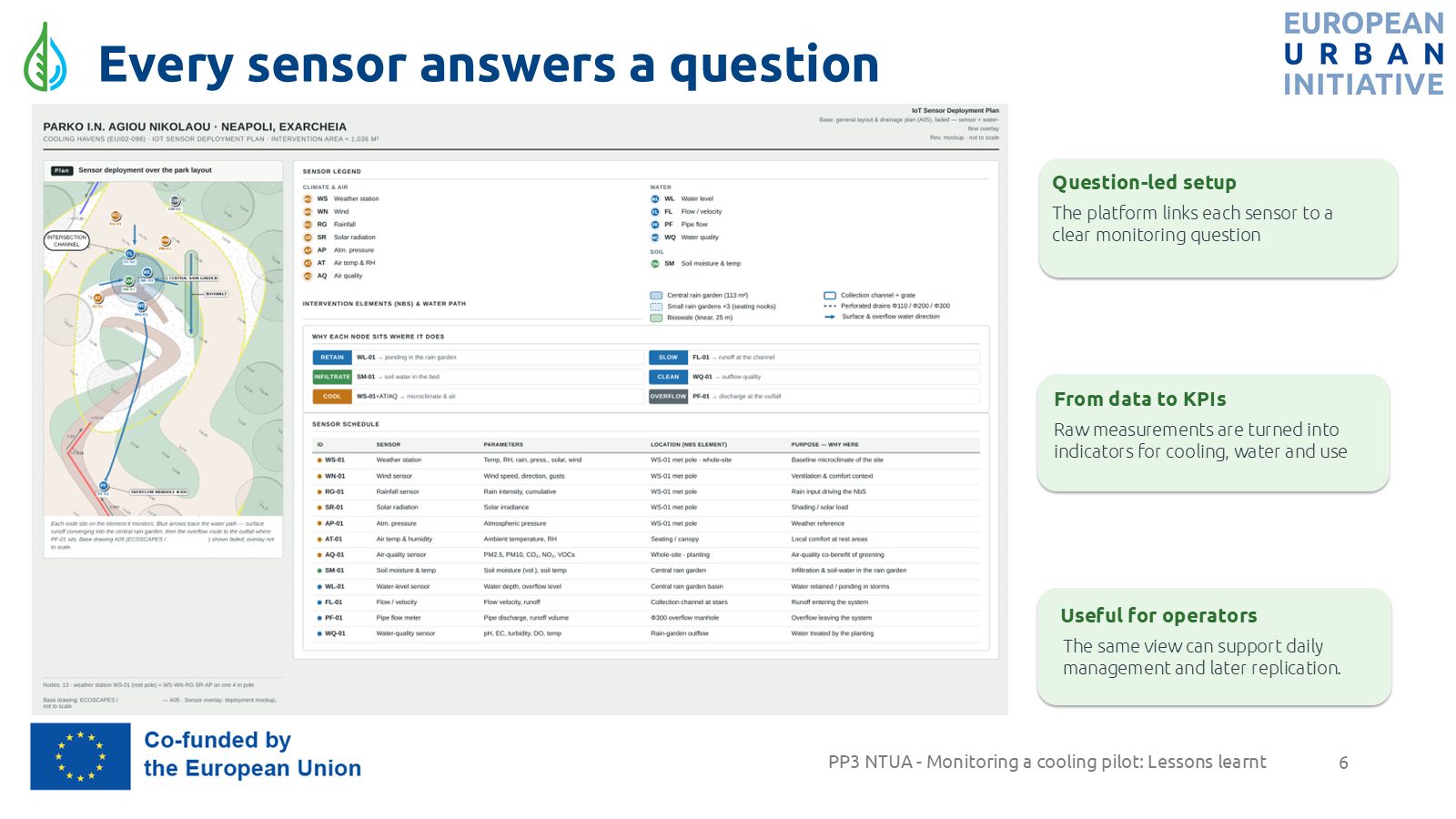
This is directly linked to choosing solutions, because the pilot has to be not only feasible but also open to evaluation.
If we decide on a shading intervention, we need to define in advance what change we expect from it. Do we want to reduce heat stress, increase the time people spend in the space, or both? If we try out smart irrigation, we need to clarify whether water consumption, soil moisture or the condition of the vegetation will show the system's value. If a new community function is introduced, its success may be indicated by use and by users' experience.
So whether the effect of an intervention can be recognised at all also becomes a selection criterion.
From this point of view, a smaller pilot linked to a clear question can often be more valuable than a complex investment made up of many elements. If too many things change at once, it becomes harder to understand which element had what effect. In the Living Lab approach, then, the aim is not to build in as many of the available technologies as possible, but to design an intervention from which we can actually learn.
This is why the Havanna professional material itself ended its presentation of solutions with open questions. At the time of the Budapest visit, the local adaptation of the Athens solutions was not yet treated as a finished plan. It still had to be examined where cooling could bring the greatest everyday benefit, how green and blue infrastructure can be reconciled with access and other land-use needs, what role residents can take on in design and maintenance, and what can be meaningfully delivered and measured within the pilot's timeframe.
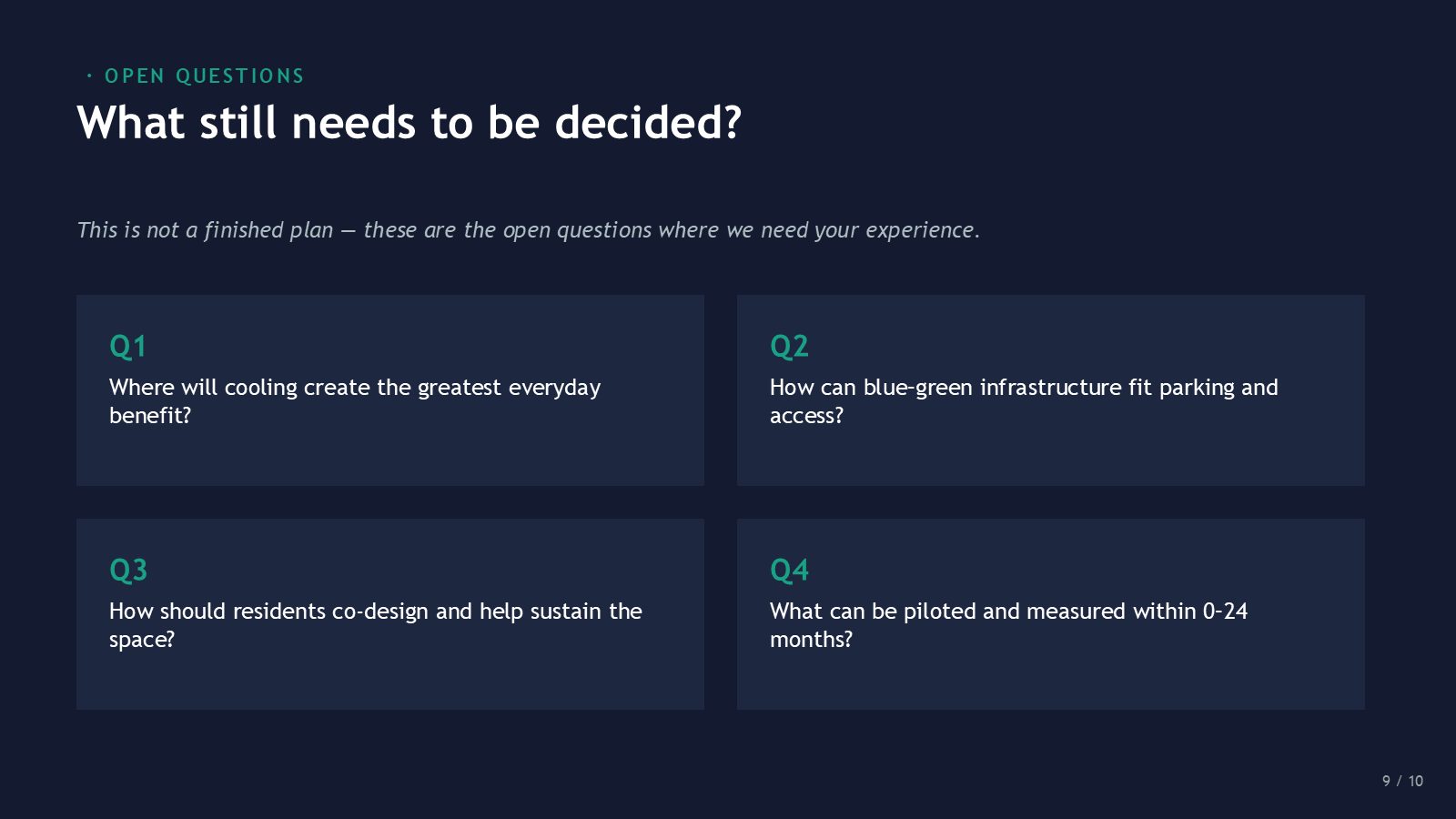
This openness is an important part of the professional process. It does not mean there is no clear development direction. It means that the different options still have to be assessed against the actual local conditions.
A promising solution may turn out not to be installable where it was originally planned because of utilities. For another, maintenance costs may become too high. A user study may show that it would be more needed elsewhere. And measurement results may later even show that a smaller intervention had a greater effect than we had anticipated.
Choosing solutions is therefore not a single moment of decision.
It is a process of gradual refinement.
It starts with understanding the site, and is then shaped by users' experience, technical possibilities and international examples. In the next step, costs, permitting and maintenance conditions come into play. And before anything is finalised, we also need to define what result we expect and how we will observe it.
In this process, ruling out an option can be just as valuable a professional result as choosing a solution.
If it turns out that a technology requires too much water, too much maintenance capacity or a disproportionate investment at a given site, documenting this also helps later projects. If an intervention only works under certain conditions, that condition itself becomes part of the transferable knowledge.
Image gallery
Related materials
Background materials to download
Would you like to work with us?
Research, methodological support and solutions tested in real-world settings – for local authorities, institutions and researchers.