
Workshop Journal · Cooling Havens
Lessons from Athens, questions for Havanna – learning together at the Cooling Havens site visit in Budapest
One of the hardest questions in urban climate adaptation is no longer whether suitable technical solutions exist. Many European cities are experimenting with shading, planting, water retention, smart irrigation, environmental sensors and the reduction of sealed surfaces. The harder task is deciding which of these can work in a particular neighbourhood, in what order to intervene, how to measure the results, and who will look after the new systems years after the investment has been completed.
These questions took centre stage in Budapest on 7–9 September 2026, when the international partners of the Cooling Havens project met in the city's 18th district. The visit was at once a site investigation, a professional exchange and a joint planning workshop. The aim was not simply to adopt a solution from Athens, but to explore how knowledge gained in another city can be translated to the specific physical, social and institutional setting of the Havanna housing estate.
This is precisely what makes the Budapest meeting so important for the Living Lab. Here, international knowledge transfer did not mean presenting a finished piece of good practice, but the start of a process that can be studied. The question was how experience becomes a local hypothesis, how a hypothesis becomes an intervention that can be tested, and how that intervention then yields knowledge that is measurable and can later be interpreted in other settings too.
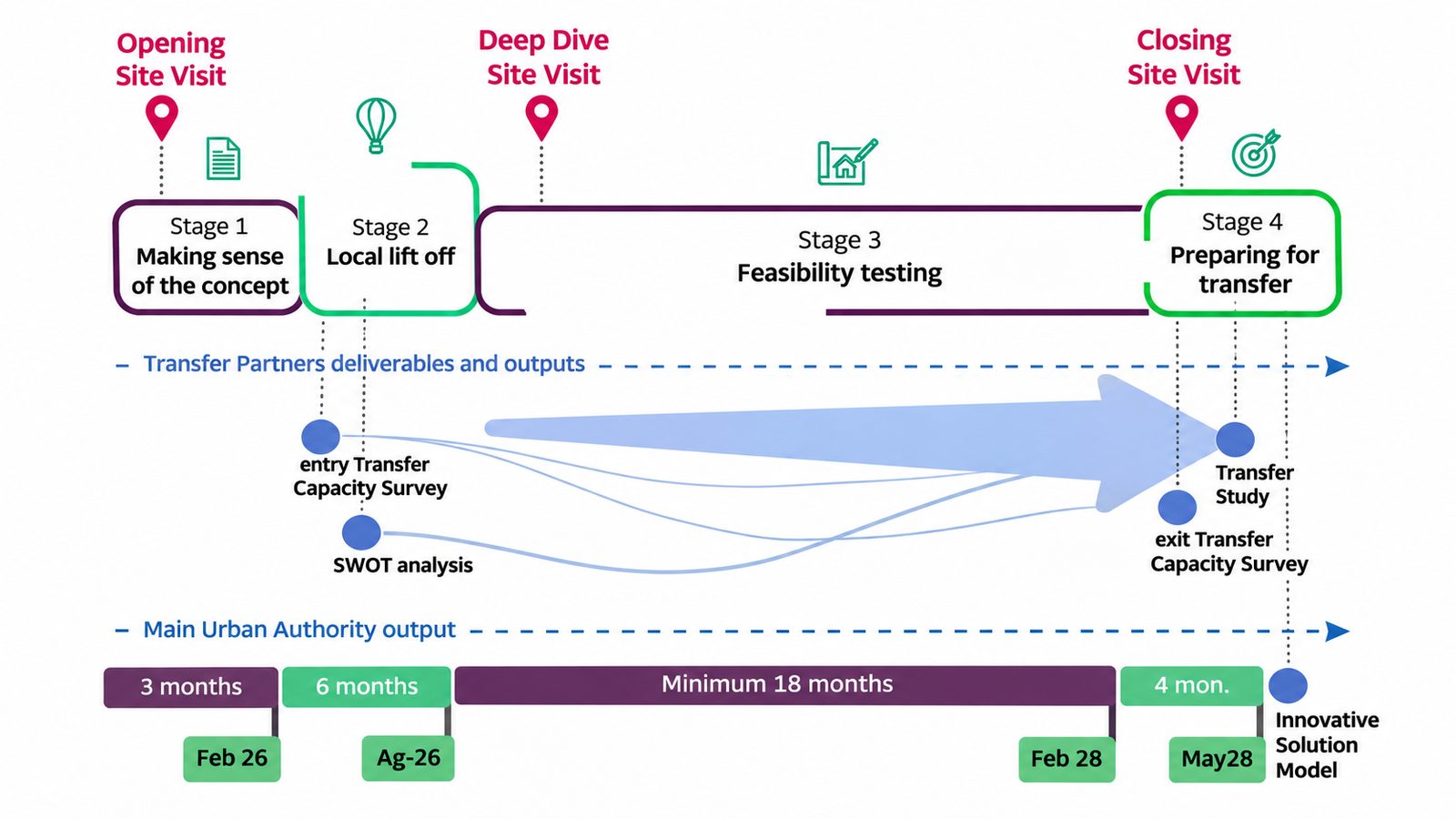
The project timeline shows the logic behind this thinking. The project moves from understanding the concept, through local adaptation and feasibility testing, to a transferable solution model. In this process the in-depth site visit to Budapest is not an end point but a point of transition. The experience gathered here has to inform the planning, measurement and implementation decisions of the period ahead.
On the Havanna estate, climate adaptation is a very concrete question
The particular characteristics of the Havanna housing estate quickly made it clear that climate adaptation here cannot be narrowed down to a single technological problem. When the neighbourhood was built, planning was driven by very different considerations from those that come to the fore today when designing a liveable, climate-resilient public space.
Around 13,300 people live on the estate. Dense development, large sealed surfaces, limited shade and summer heat stress together create an environment in which the effects of climate change show up directly in people's everyday wellbeing. Heat here is not just a meteorological figure: it is a question of how usable a walking route is in summer, whether an older person can find shade, how long children can stay outdoors, and whether a public space is inviting during the hottest hours of the day.
The local background analysis highlighted four interconnected challenges: summer heat stress, the use of public spaces, the condition of green and blue infrastructure, and mobility and parking. The links between these four areas are crucial. New planting needs space. Keeping water on site means rethinking surfaces. Improving pedestrian connections may affect parking. And shading and community functions only bring a real improvement if people are actually able to use the new space.
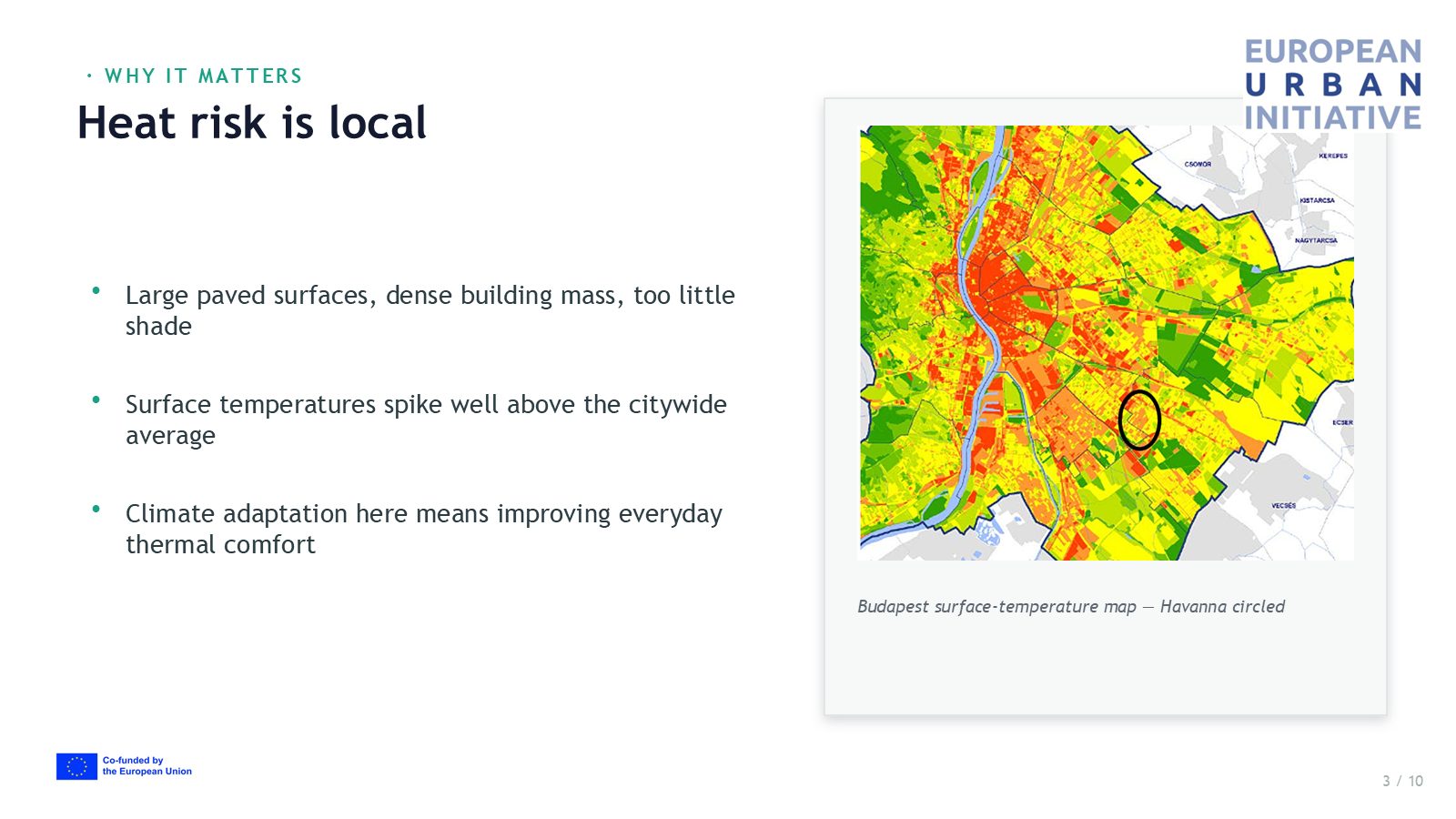
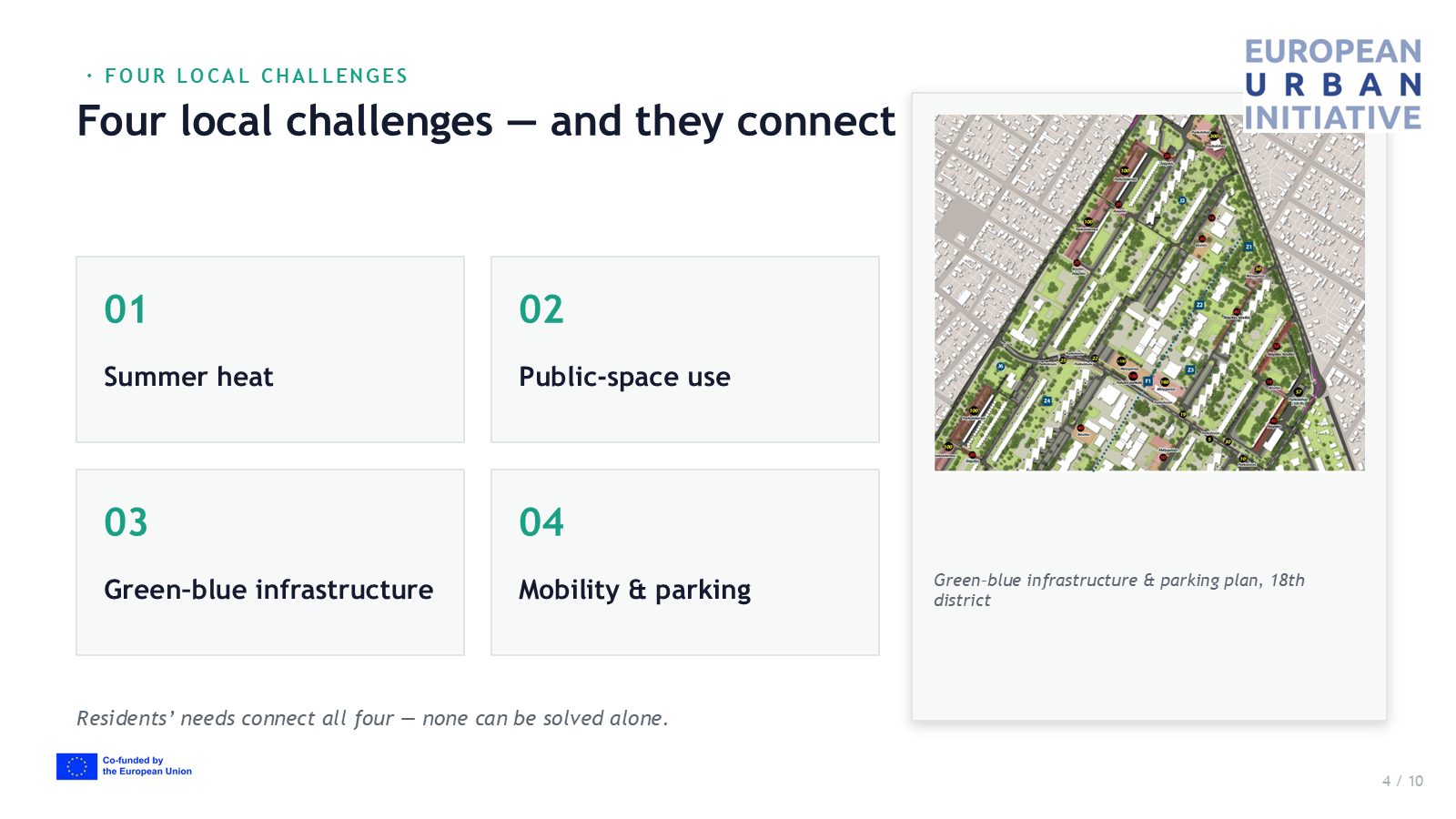
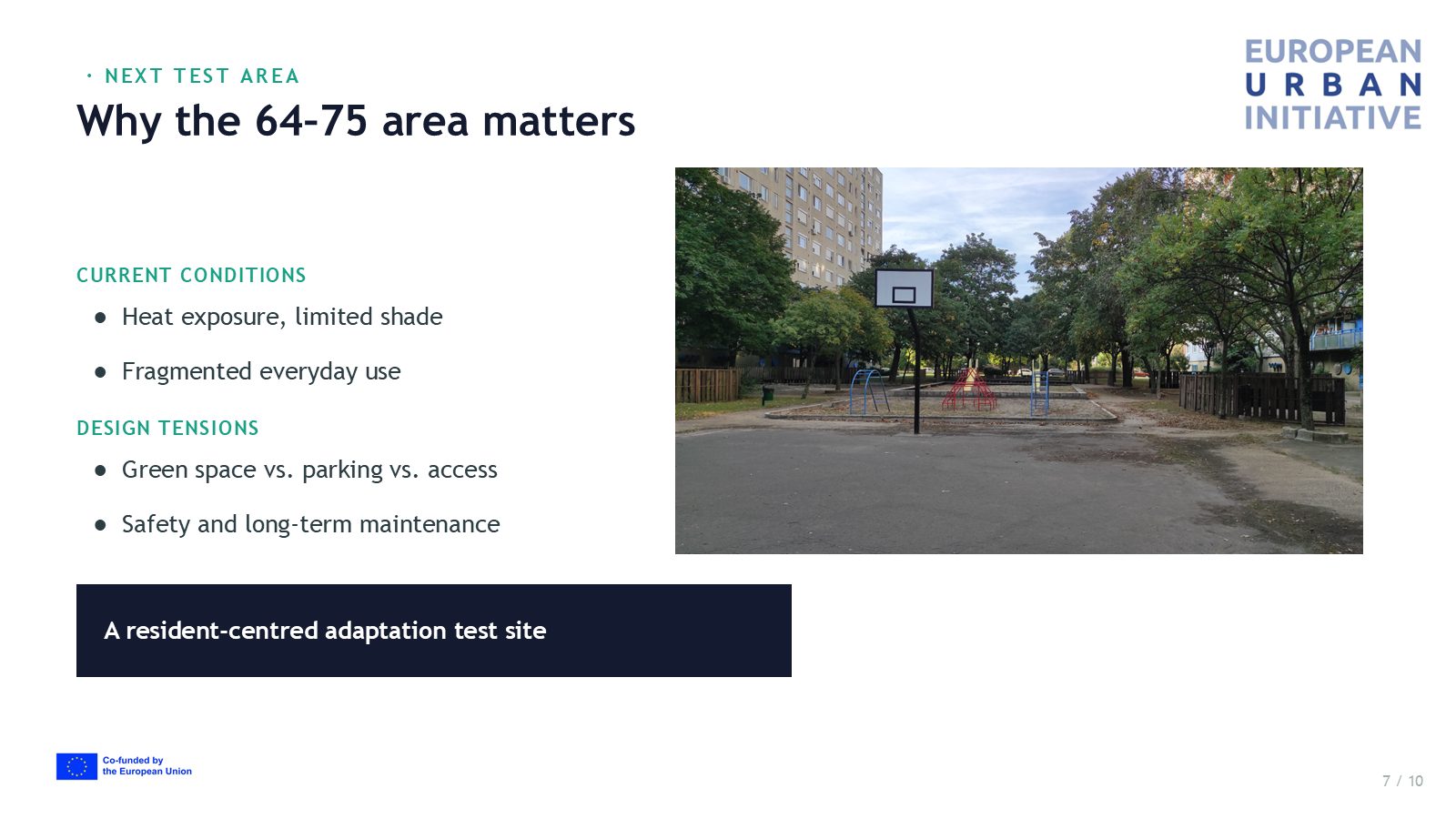
The area between numbers 64 and 75 is therefore much more than a potential investment site. It can also be understood as an experimental space: a place where the relationships between thermal comfort, shading, water management, transport, safety, accessibility and community use can be examined together.
An important lesson from the Budapest preparatory material is that earlier developments in the area already provide local experience. The renewal of Kondor Béla sétány, the redevelopment of the Havanna market and the use of the community gardens show that, alongside the quality of the physical environment, actual use, participation and maintenance also determine how effective an intervention is in the longer term.
Three basic lessons can be drawn from this. Use matters at least as much as the design itself. Participation can strengthen local attachment and a sense of responsibility. And the approach to maintenance, and its costs, must be clarified at the very start of planning.
The task was not to choose solutions, but to establish order and connections
An interactive adaptation workshop was an important part of the work on site. Participants were asked to imagine that Havanna was their own neighbourhood: which three interventions would they start with, and on what professional grounds would they rank them?
The options included shading and nature-based cooling, smart irrigation, environmental monitoring, safe and accessible infrastructure, smart lighting, and the use of open data and more advanced management systems.
The exercise was especially useful because it did not let every good idea automatically take priority. Participants had to choose. This made visible the professional considerations that are also decisive in a real municipal decision.
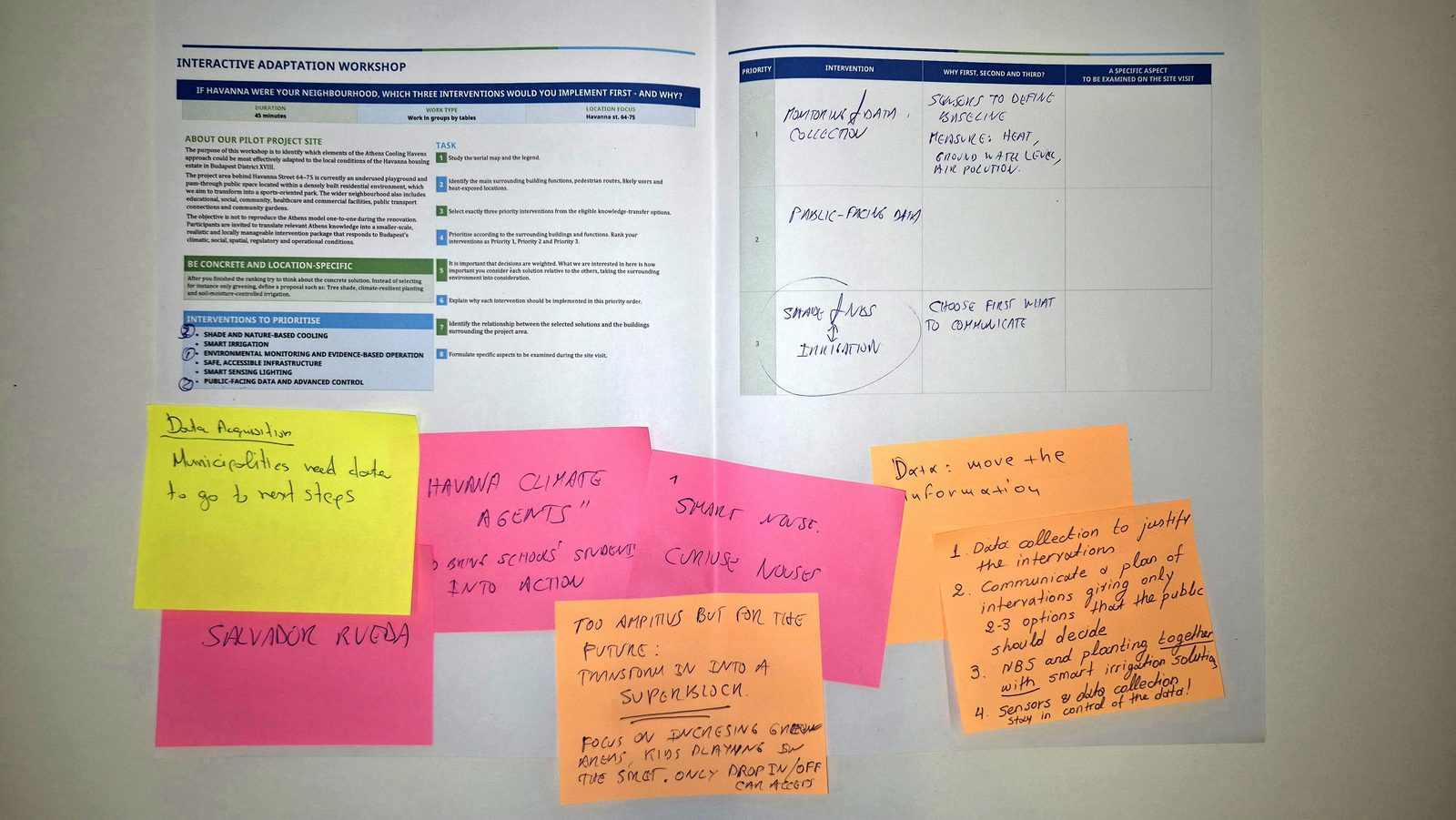
One working group put data collection and environmental monitoring first. They argued that without measuring temperature, soil moisture, groundwater level and air pollution, it is hard to decide exactly which intervention is justified. They ranked open data second and smart lighting third.
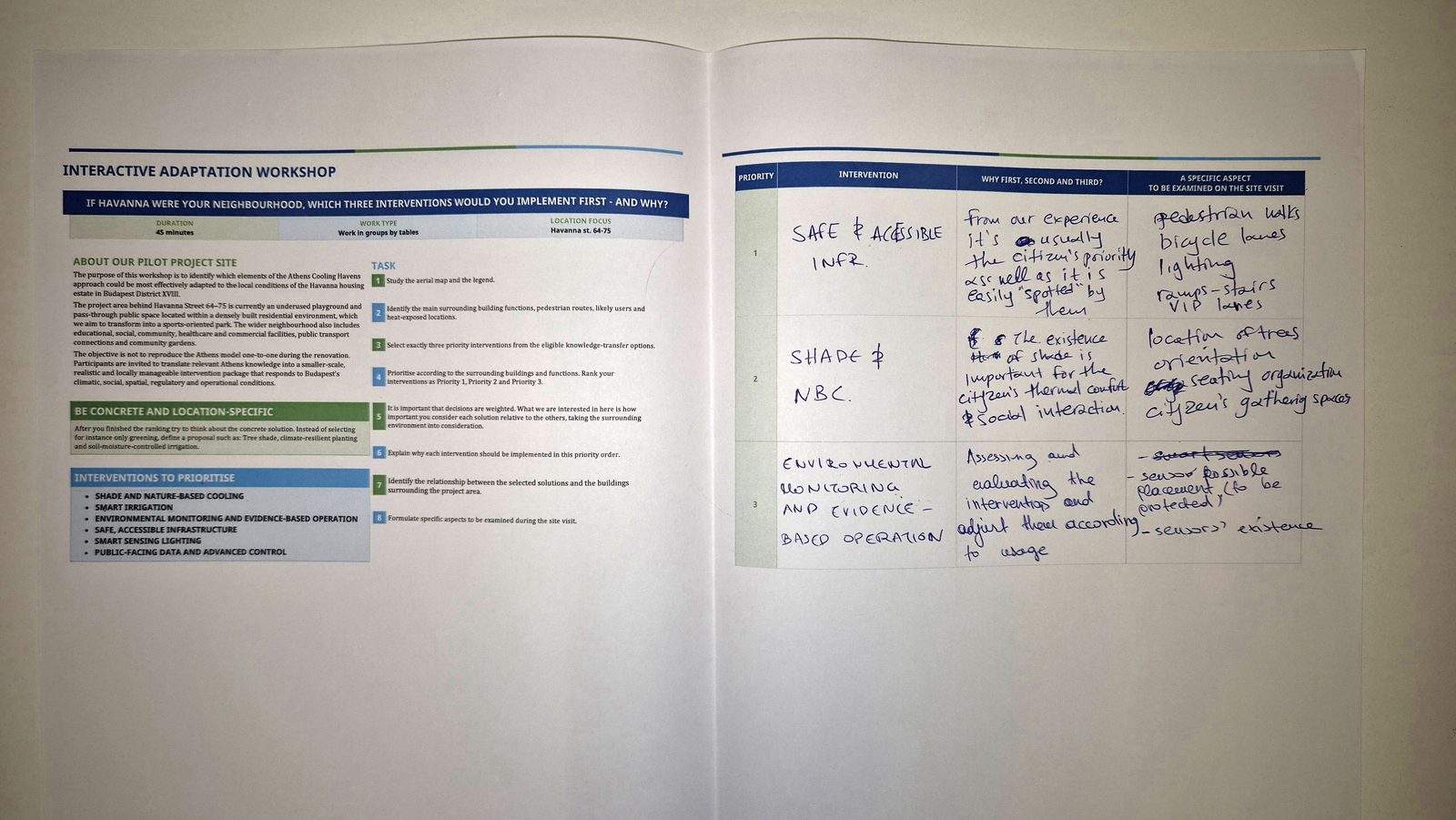
Another group saw safe and accessible infrastructure as the top priority. The quality of walking routes, cycle links, lighting, steps and ramps emerged as a foundational layer without which cooling and greening solutions will not necessarily become truly usable. Shading and nature-based cooling came next, followed by environmental monitoring and evidence-based operation.
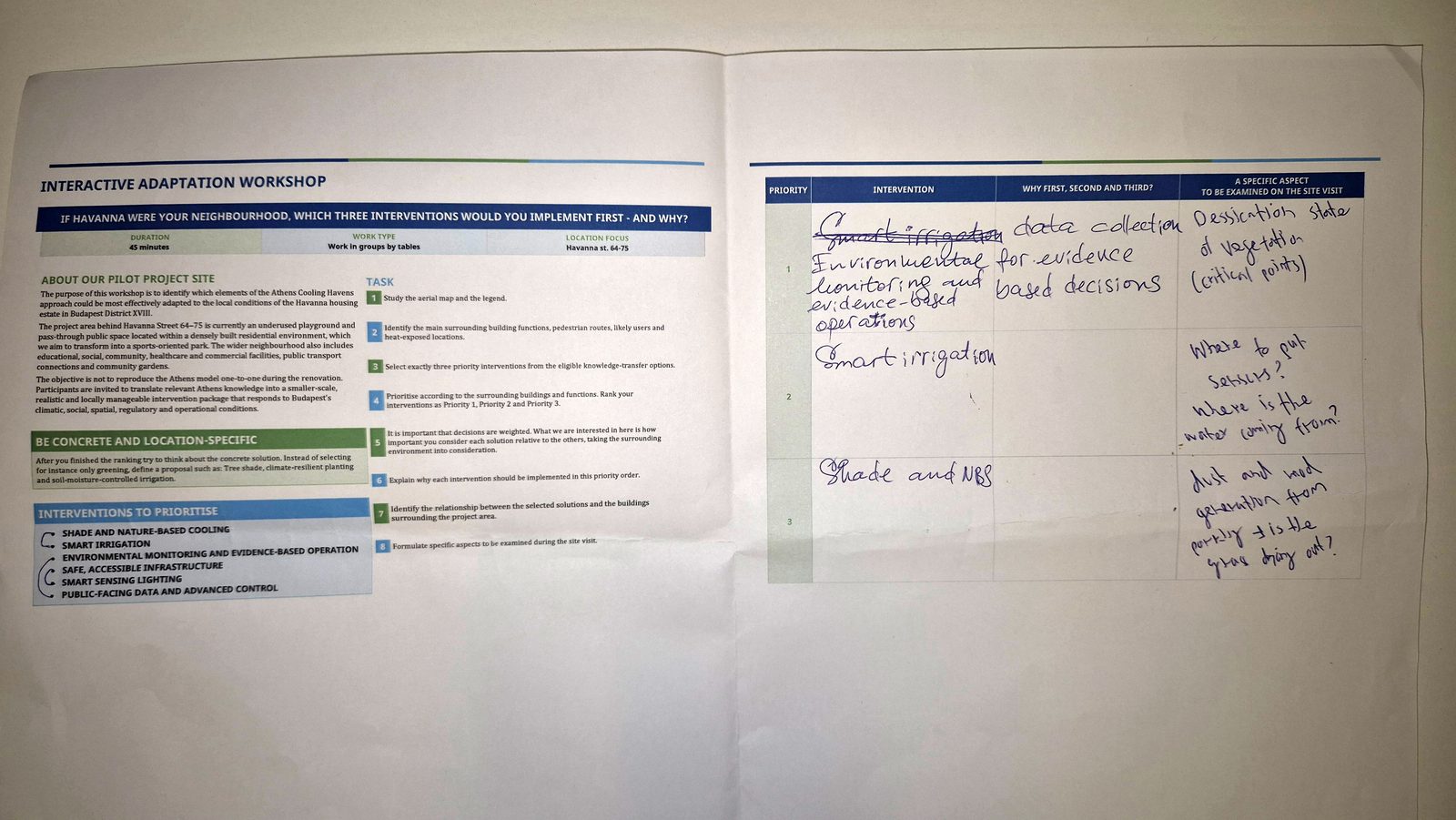
The third working group also started from measurement. It placed environmental monitoring first, smart irrigation second, and shading and nature-based solutions third. The group's notes already raised specific site questions. Where are the critical points for vegetation? Where could irrigation water come from? Where should the sensors go? How can dust and the heat radiating from buildings be reduced?
Taken together, the three sheets matter more than any one of them alone. No fully unified ranking of technologies emerged, but the decision-making logic converged at several points. Measurement has to precede some of the interventions. Accessibility and safety cannot be treated as secondary. Shading and water management must be tailored to the specific spatial structure of the site. And operation has to be considered already at the design stage.
This approach is also close to the Living Lab way of thinking. An intervention should not simply be built, but designed so that the baseline, the change and the consequences of use can all be observed.
Three partner cities, three different backgrounds of experience
The value of the Budapest meeting was greatly increased by the fact that the partners did not bring general policy recommendations with them, but experience from earlier urban projects.
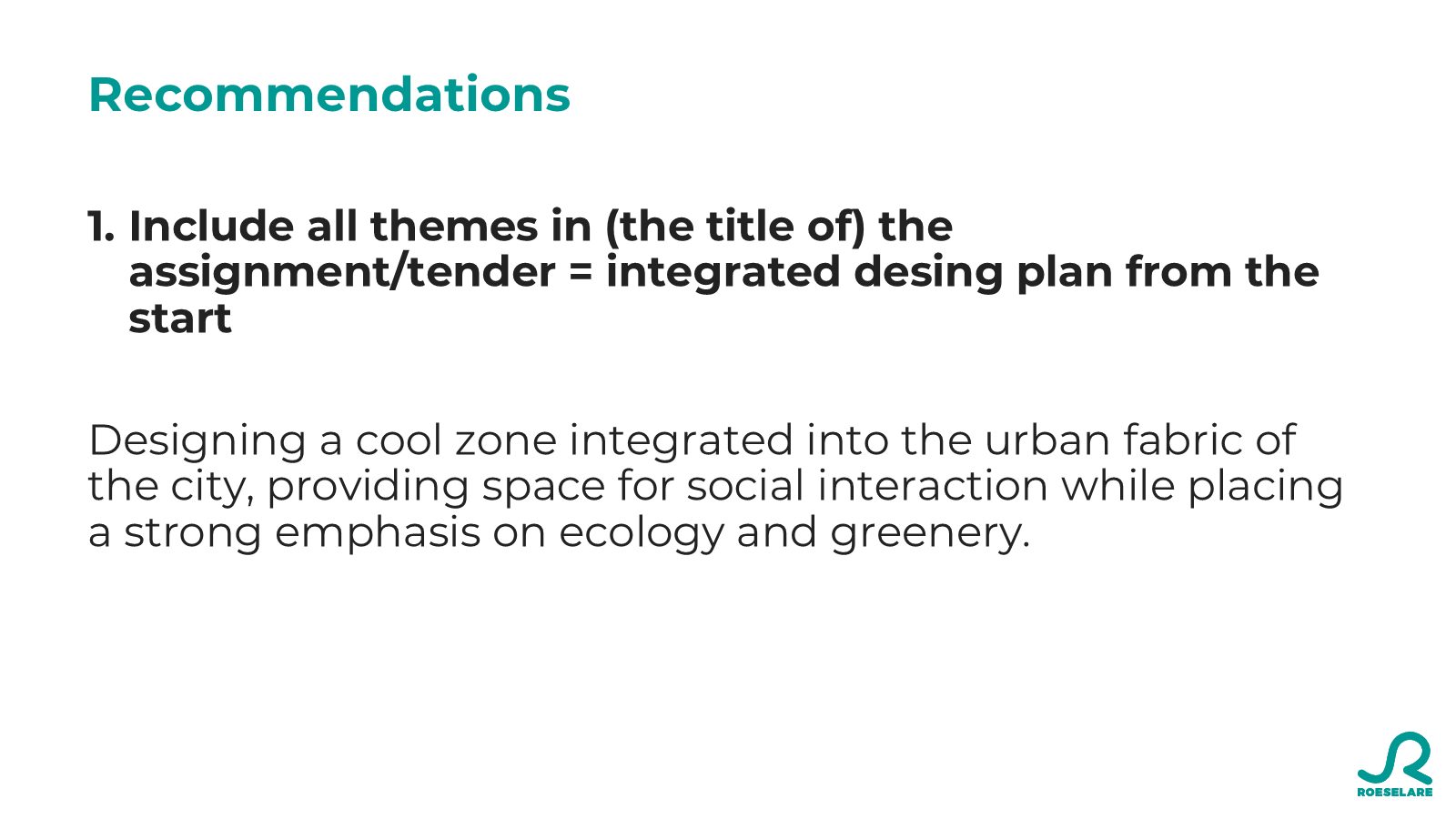
The example of Roeselare showed particularly clearly the importance of participation and integrated planning. In an earlier project, the originally planned de-sealing of around 1,600 square metres grew to nearly 7,000 square metres through joint work with local stakeholders. In this case participation did not merely build social acceptance; it contributed directly to a more ambitious climate adaptation outcome.
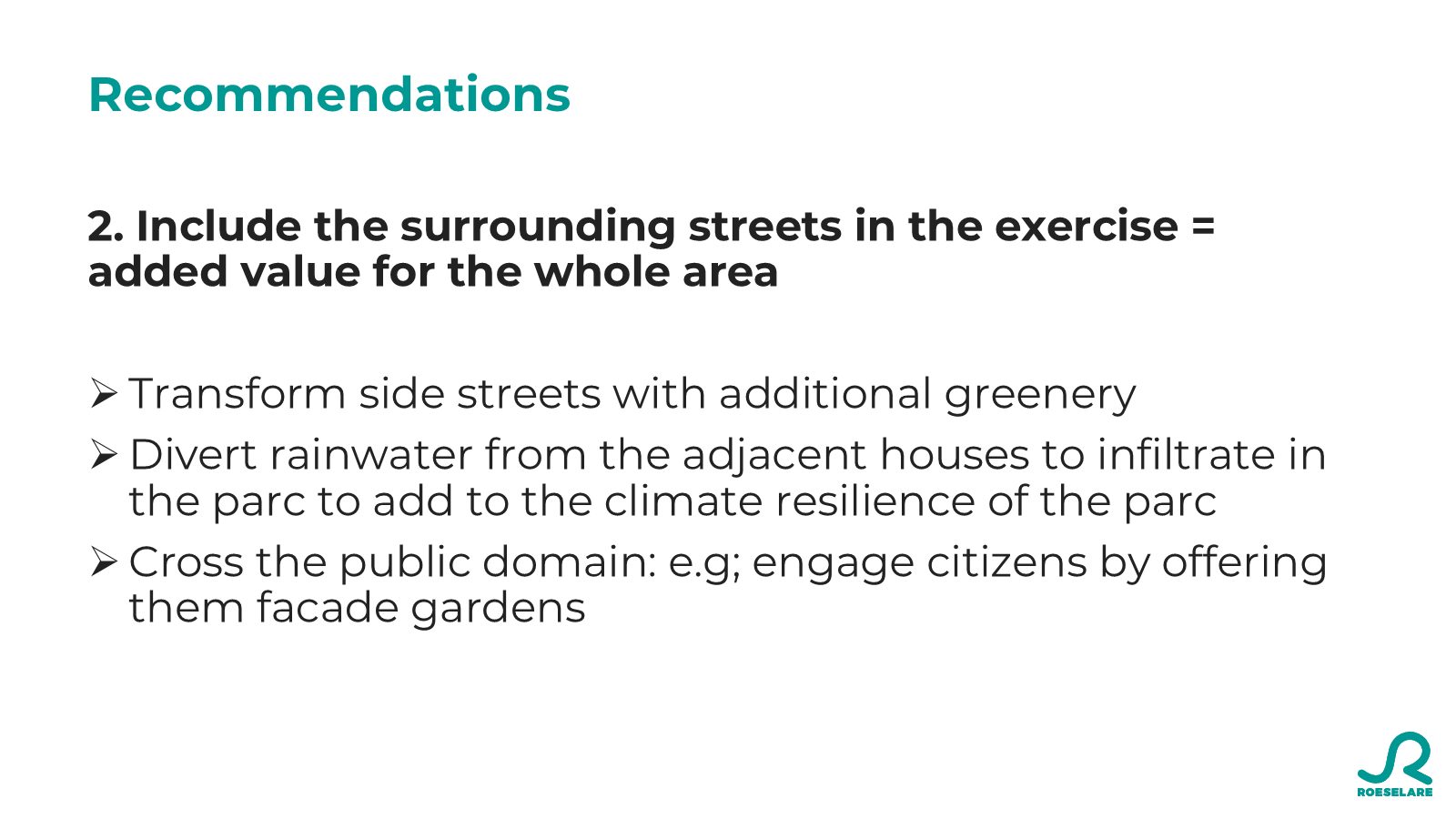
The Belgian experience also underlines that it is not necessarily wise to stop the intervention area at the legal boundary of a park or square. Bringing in the surrounding streets, rainwater from adjoining buildings, greening in front of façades and pedestrian connections can produce a wider area-level impact.
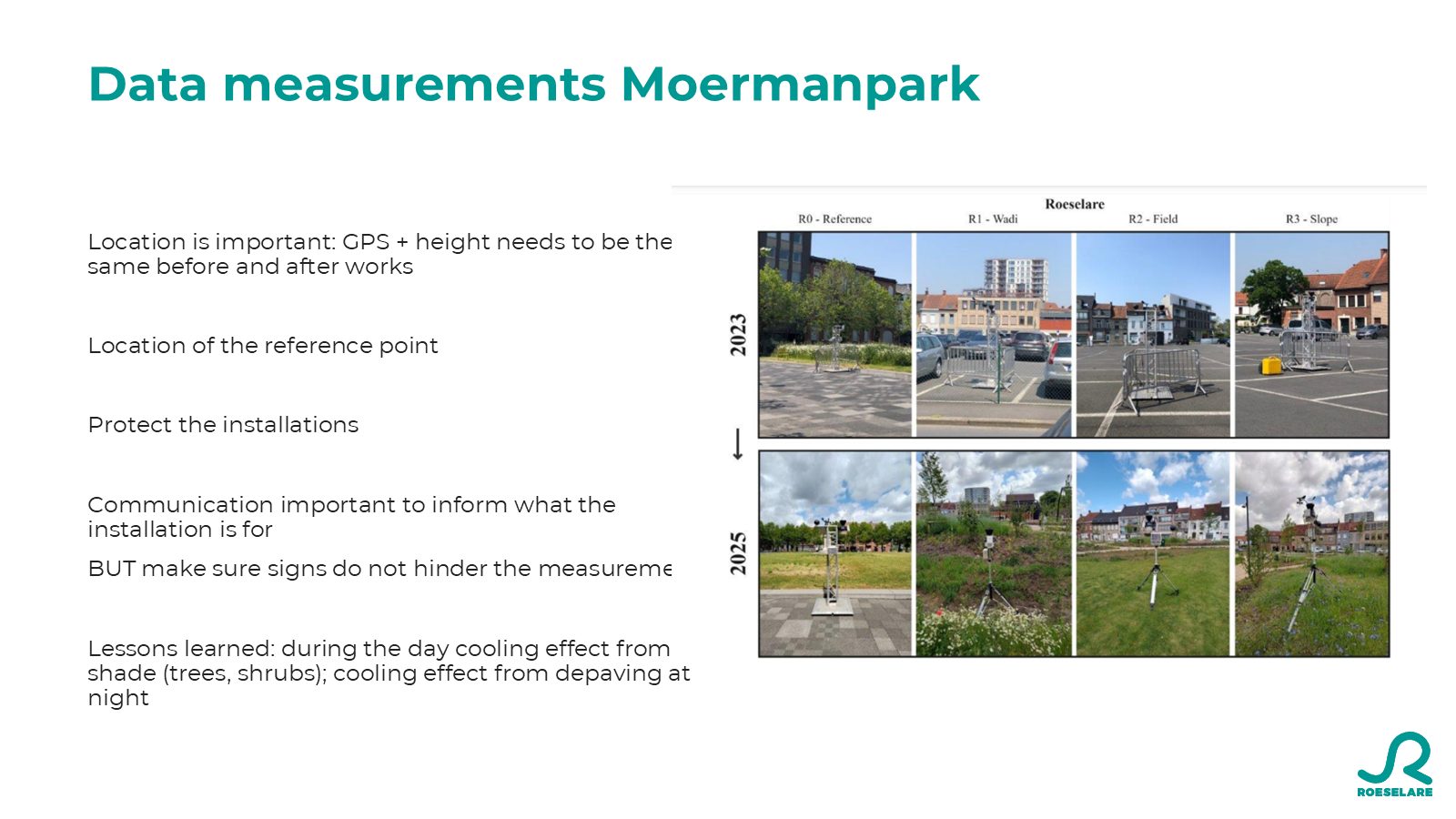
Roeselare's experience with measurement is just as important. If we want to compare conditions before and after a project, the location and height of the measuring point must remain consistent. The instruments need to be protected, and residents need to be told what they are for. Yet even the placement of an information sign can influence the measurement. It seems a small detail, but it shows clearly that in evidence-based urban development the measurement protocol is itself a design task.
Experience suggests that shading can have a noticeable effect during the day, while reducing sealed surfaces can do so for night-time cooling. This matters because urban thermal comfort is not determined by a single time of day or a single temperature value.
Sofia showed that a cooling space also has a social function
The presentations from Sofia added another important perspective to the shared discussion. The city already has cooling public spaces in operation that combine planting, shading, water-related solutions and community functions.
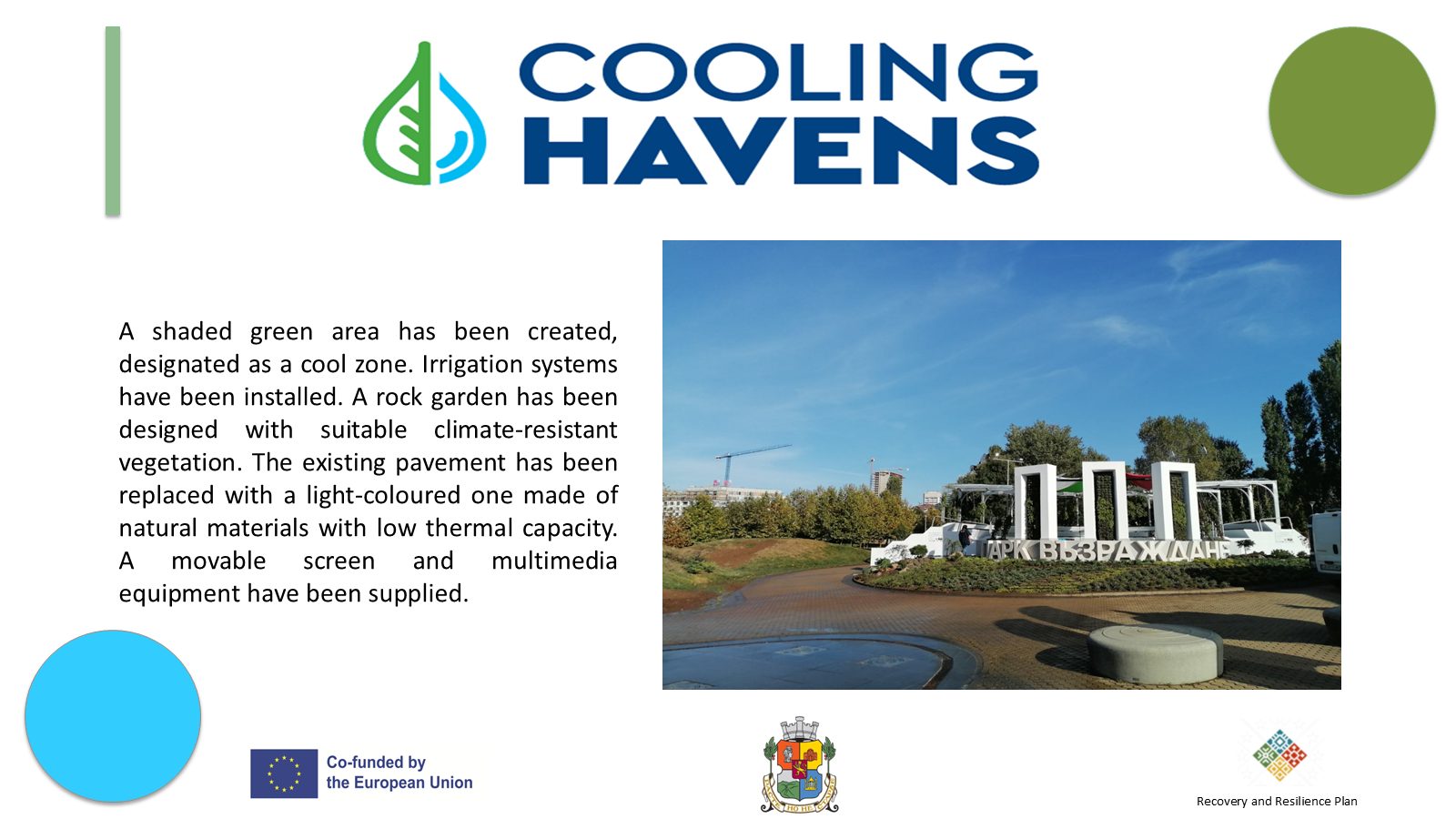
In 2023 the previously neglected amphitheatre in Vazrazhdane Park was transformed into a cooler community space. A shaded green area, an irrigation system, climate-resilient planting and light-coloured paving with low heat storage were installed. The space works not only as a place to rest but also hosts educational and environmental programmes.
At another demonstration site in Sofia, planting, permeable ground, a fountain, misting, rainwater harvesting, composting and community use come together. More than 130 residents were involved in planning and creating it. The site is used for meeting, relaxing, board games, neighbourhood events and the shared care of the area.
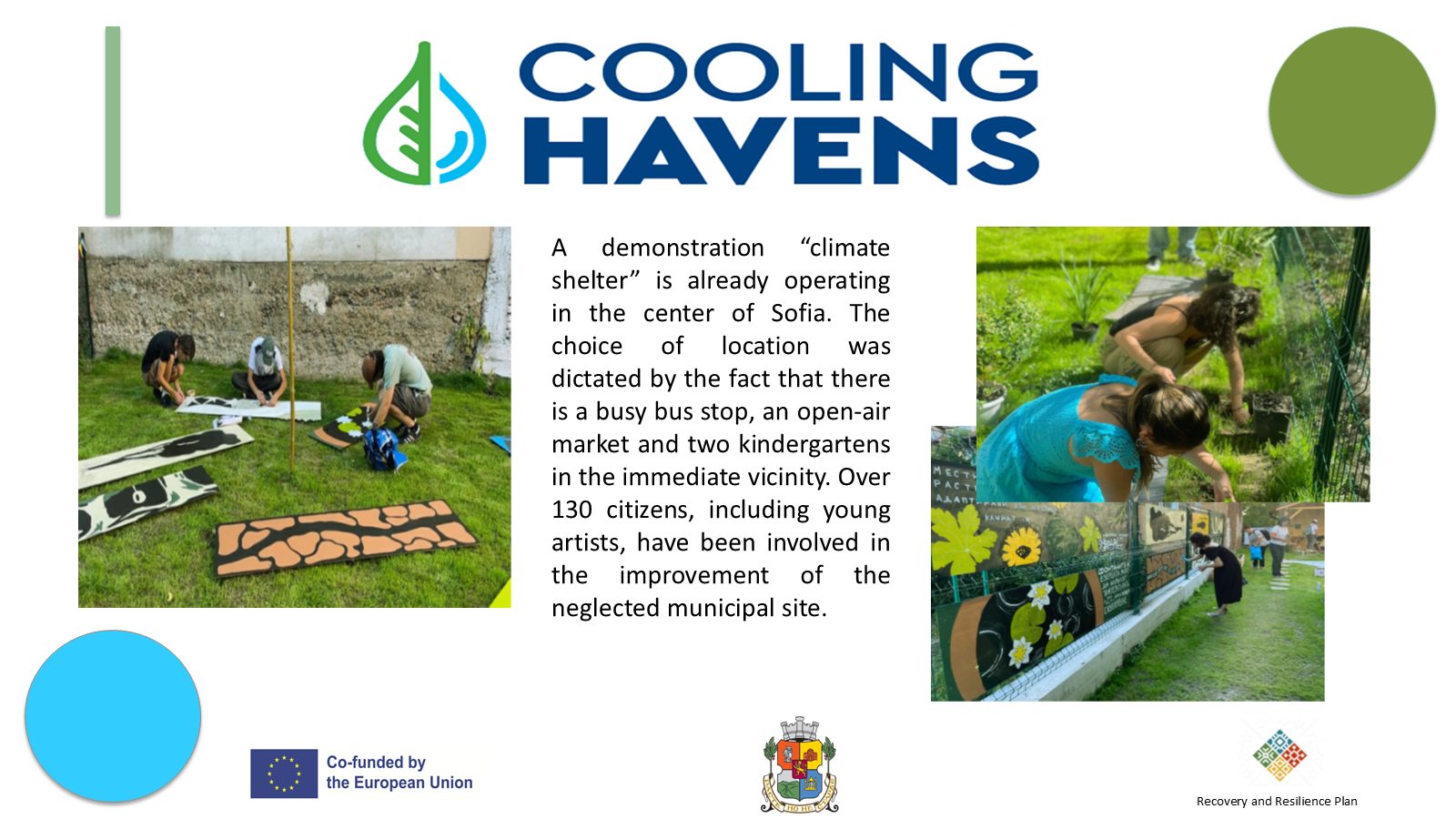
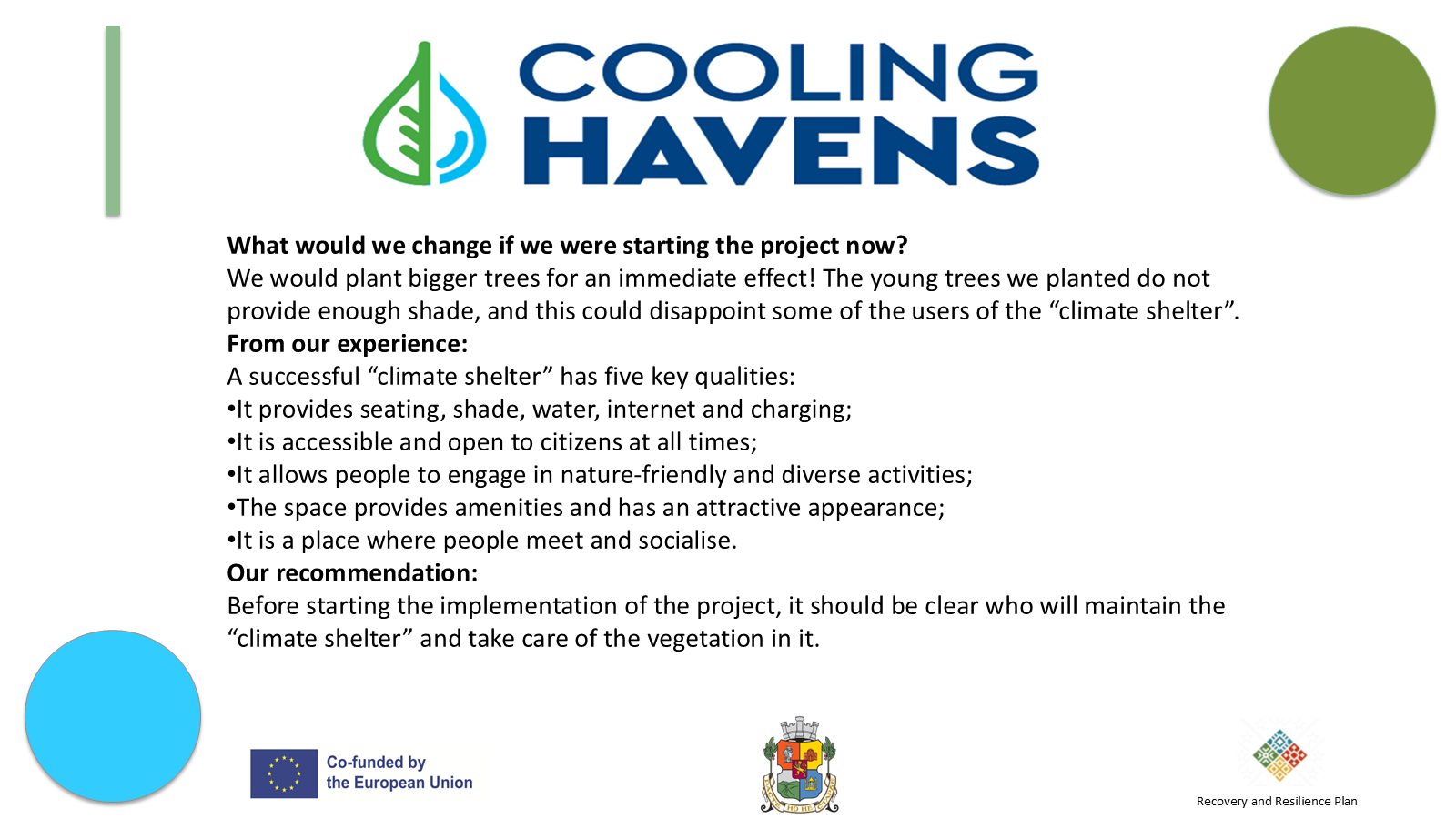
The Sofia team's own retrospective assessment is particularly instructive for Havanna. If they could start one of the projects again, they would plant larger trees, because young trees do not yet provide enough shade in the short term. This remark points to a common urban development dilemma: nature-based solutions mature over time, while users' expectations arise the moment a space is opened.
According to the Sofia experience, a well-functioning cooling public space needs seating, shade, water, accessibility and attractive community functions. Just as important, however, is maintenance. It must be clear before implementation who will look after the place, and especially the planting.
The Sofia partner's other presentation placed the same thinking at a larger urban scale. The Green Health Corridors and the planned Green Ring show how formerly neglected railway lines, rivers, parks, residential areas, and walking and cycling routes can be linked into a larger green infrastructure system. The planned ring would form a network of around 32 kilometres and, according to the analysis presented, would bring green space within walking distance of more than 247,000 people.
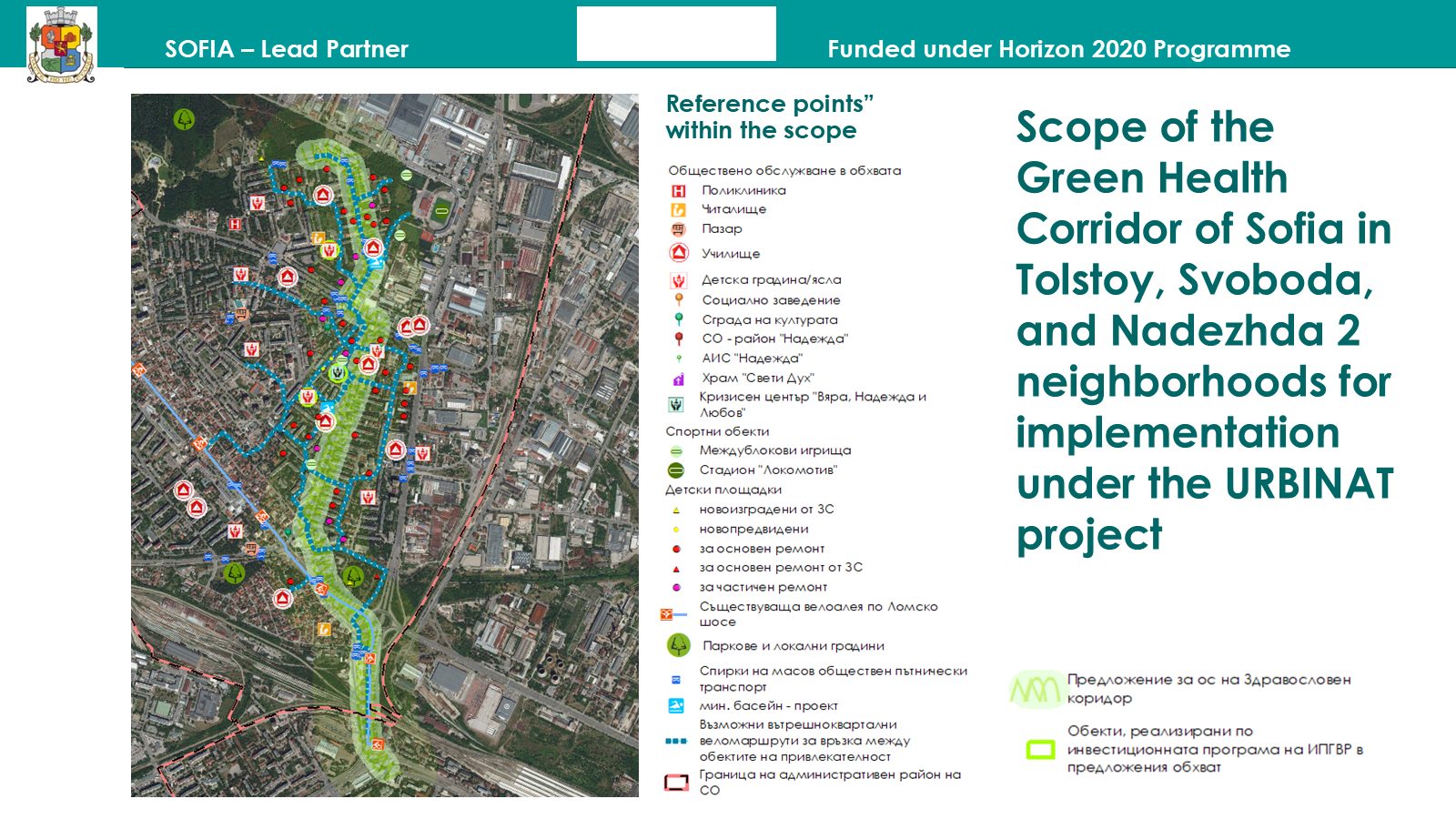
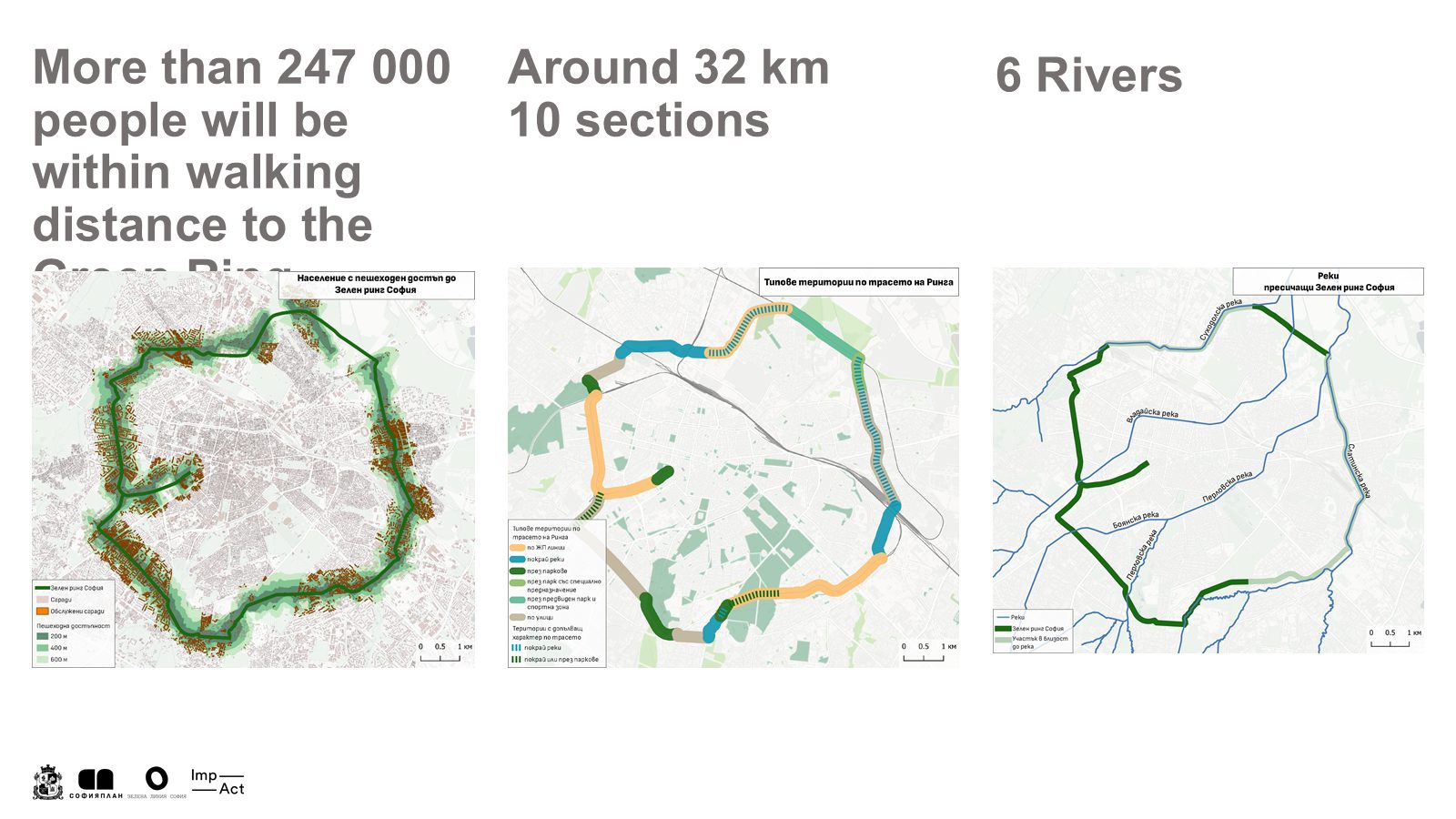
The Havanna experiment is, of course, on an entirely different scale. The methodological lesson, however, is transferable. The value of a green intervention does not depend solely on what happens inside the designated area. It also matters how it connects to the surrounding streets, institutions, residential buildings and everyday routes.
Athens did not bring a ready-made recipe
The professional starting point of the Cooling Havens project is the experience of Athens. The Athens approach brings together green and blue infrastructure working in concert, heat reduction, keeping water on site and making urban public spaces more liveable.
The September visit to Budapest was also attended by Nikos Chrysogelos, Deputy Mayor of Athens for Climate Governance and Social Economy. A summary published in the local press identified as a fundamental problem of urban adaptation that a large share of European cities were not built for today's climate. During the field visits in Budapest, water received particular attention. The alternation of heavy rainfall over short periods and longer dry spells increasingly argues for not draining water away as quickly as possible, but, where feasible, keeping it on site and using it later.
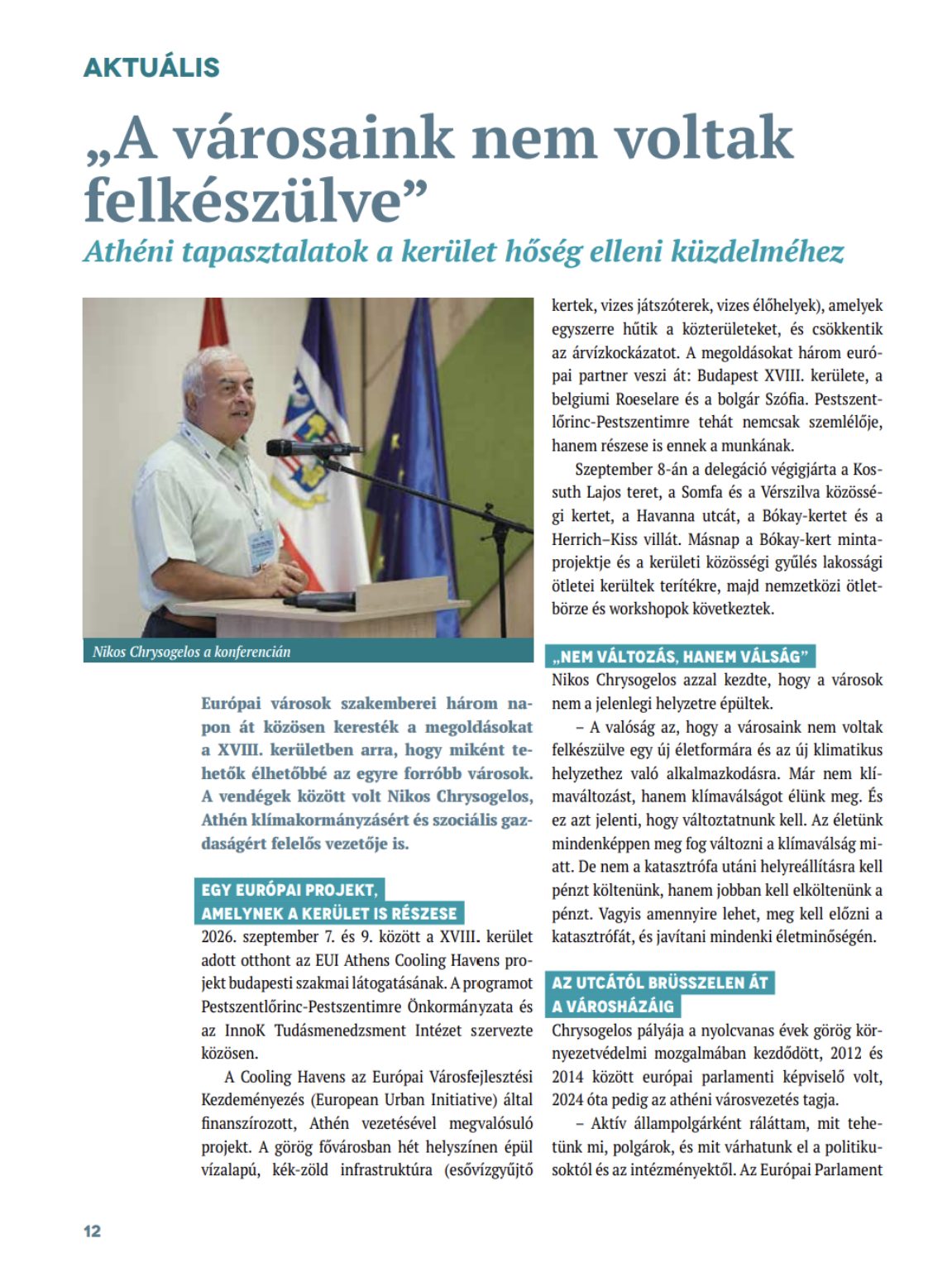
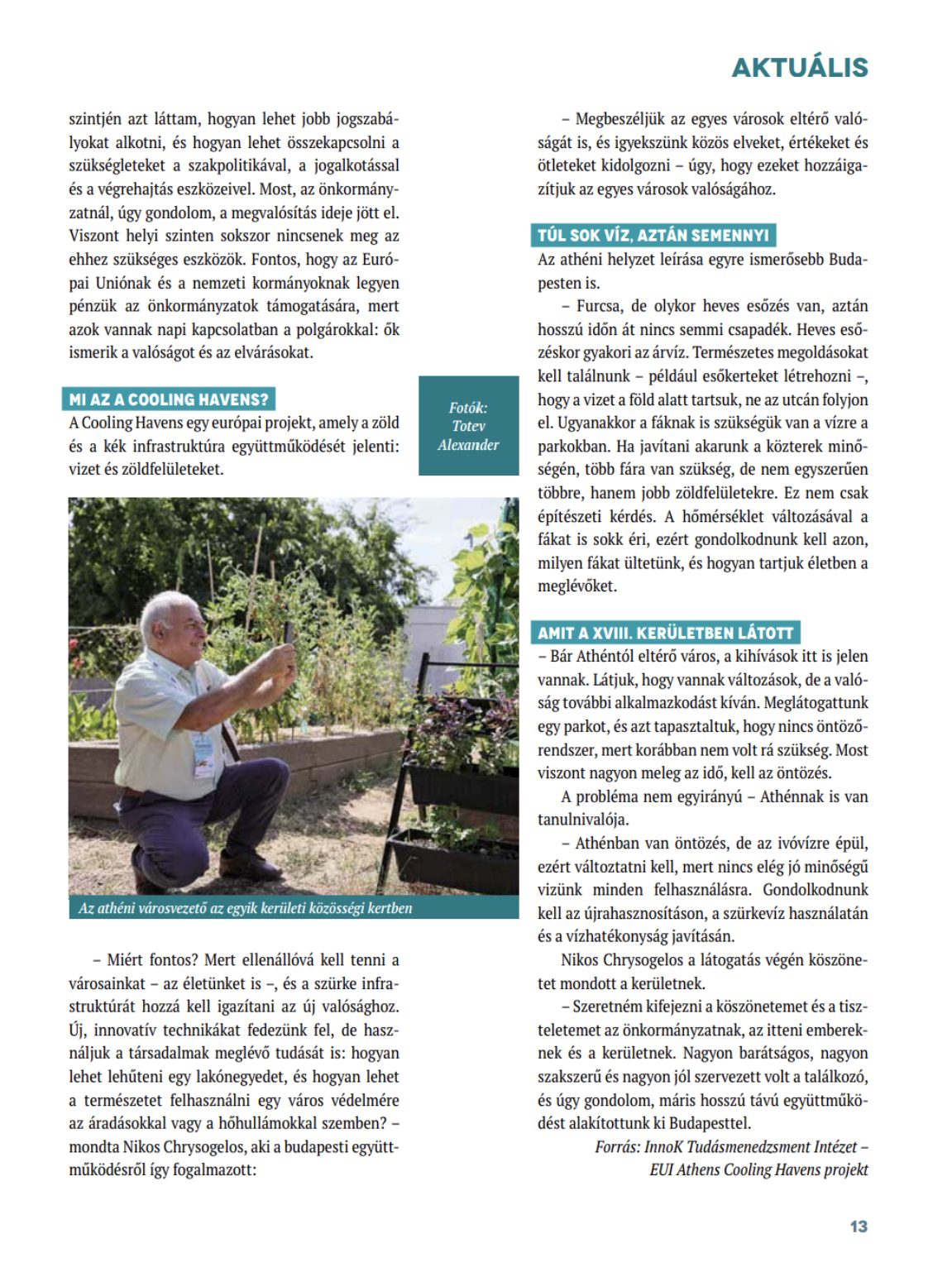
This Athens perspective also shows why it is misleading to understand knowledge transfer as copying. Budapest does not have the same rainfall pattern, vegetation, institutional system or use of public space as Athens. The principle, however, can be transferred. Urban water should be seen as a resource, and green spaces should be treated not as decoration but as infrastructure that shapes thermal comfort, the water balance, biodiversity and human use all at once.
The World Café discussions turned to the conditions for implementation
During the Budapest site visit, World Café sessions organised around three questions helped link the international experience directly to the next decisions for Havanna.
The first question asked which elements Budapest's 18th district should prioritise in the first wave of implementation so that the public space behind Havanna utca 64–75 becomes cooler, greener, more usable and more community-oriented.
Accessibility and safety, shading, the preservation of existing vegetation, lighting and smart irrigation appeared again in the answers. Several groups stressed the importance of environmental measurement. They did not simply propose collecting data, but creating a measurement baseline from which it can later be established whether the intervention actually worked.
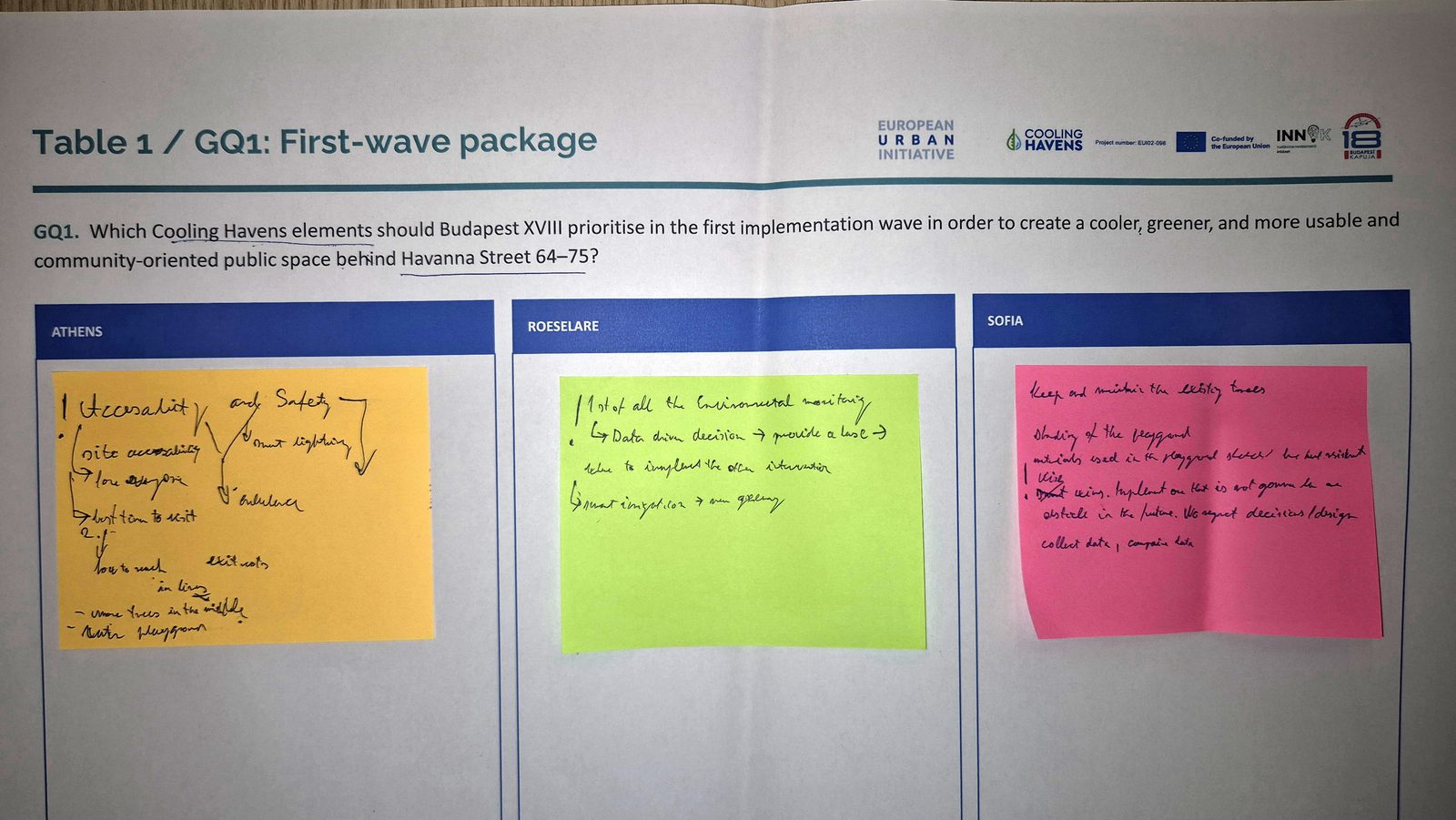
The second question focused on risks: which legal, technical, operational, financial and social factors need to be resolved before the pilot is finalised?
The notes read almost like an implementation checklist. Ownership and permitting must be clarified. Utilities must be mapped. Soil conditions must be known. The available capital and operating budget must be defined. For irrigation, the water source, storage and the sustainable operation of the system must be settled. Among the social risks, the notes also mention adequate communication and the danger that the project raises expectations it cannot later meet.
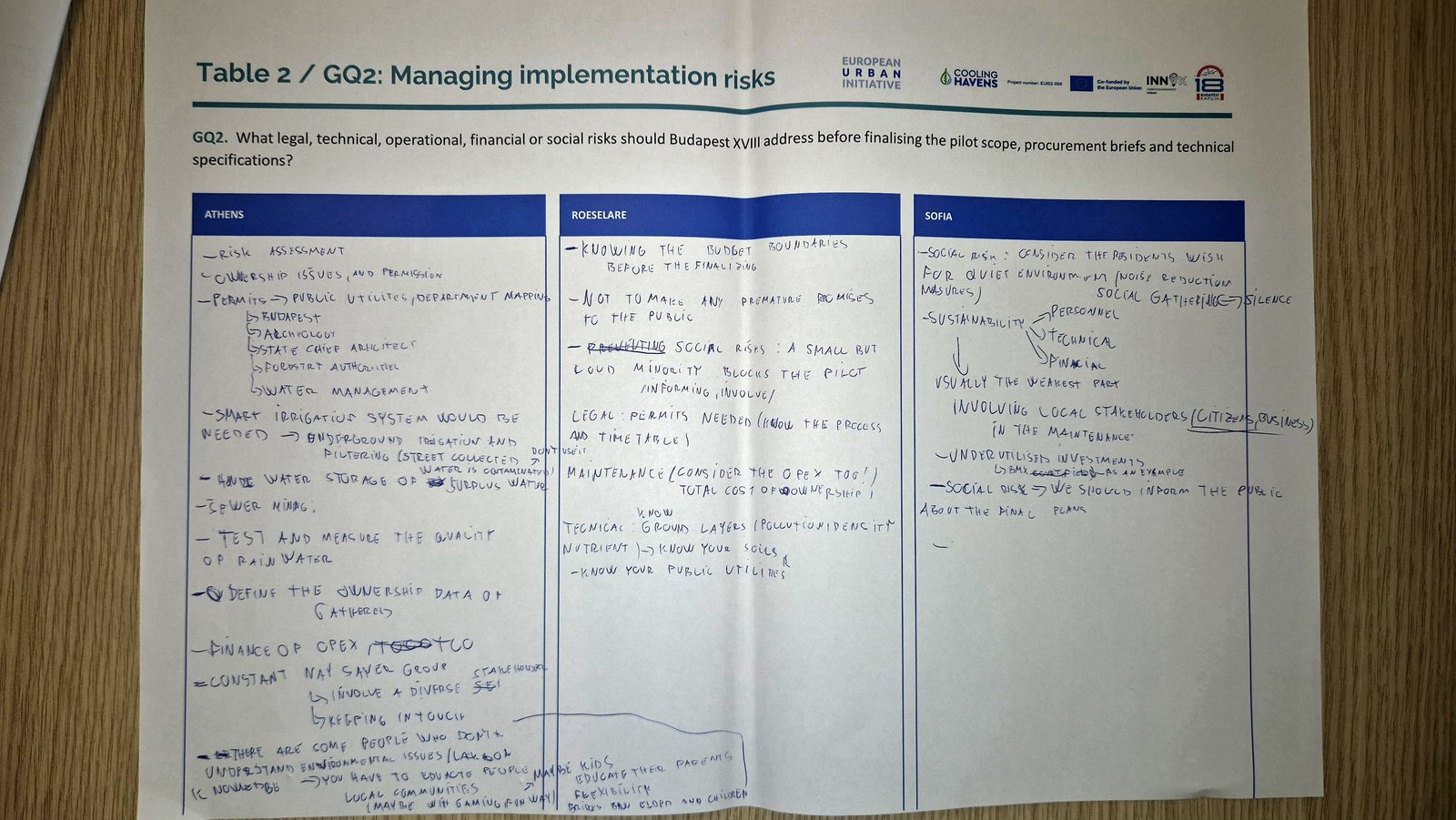
The working groups placed particular emphasis on maintenance. This is not surprising, as the experience from Roeselare and Sofia pointed in the same direction. A new green space or smart system cannot be considered finished on the day it is handed over. Caring for the planting, running the sensors, irrigation, cleaning, repairs and data management all require long-term institutional capacity.
The third World Café question explored what needs to be measured, documented and communicated during the pilot so that the results can later be interpreted by other neighbourhoods or other cities.
Here the partners were no longer talking only about environmental data. They proposed documenting the participatory process, collecting feedback from residents, measuring maintenance costs, evaluating the impact of the intervention and developing a shared set of indicators. Another point raised was the need to communicate not only what was delivered, but also why a particular decision was made and why other options were rejected.
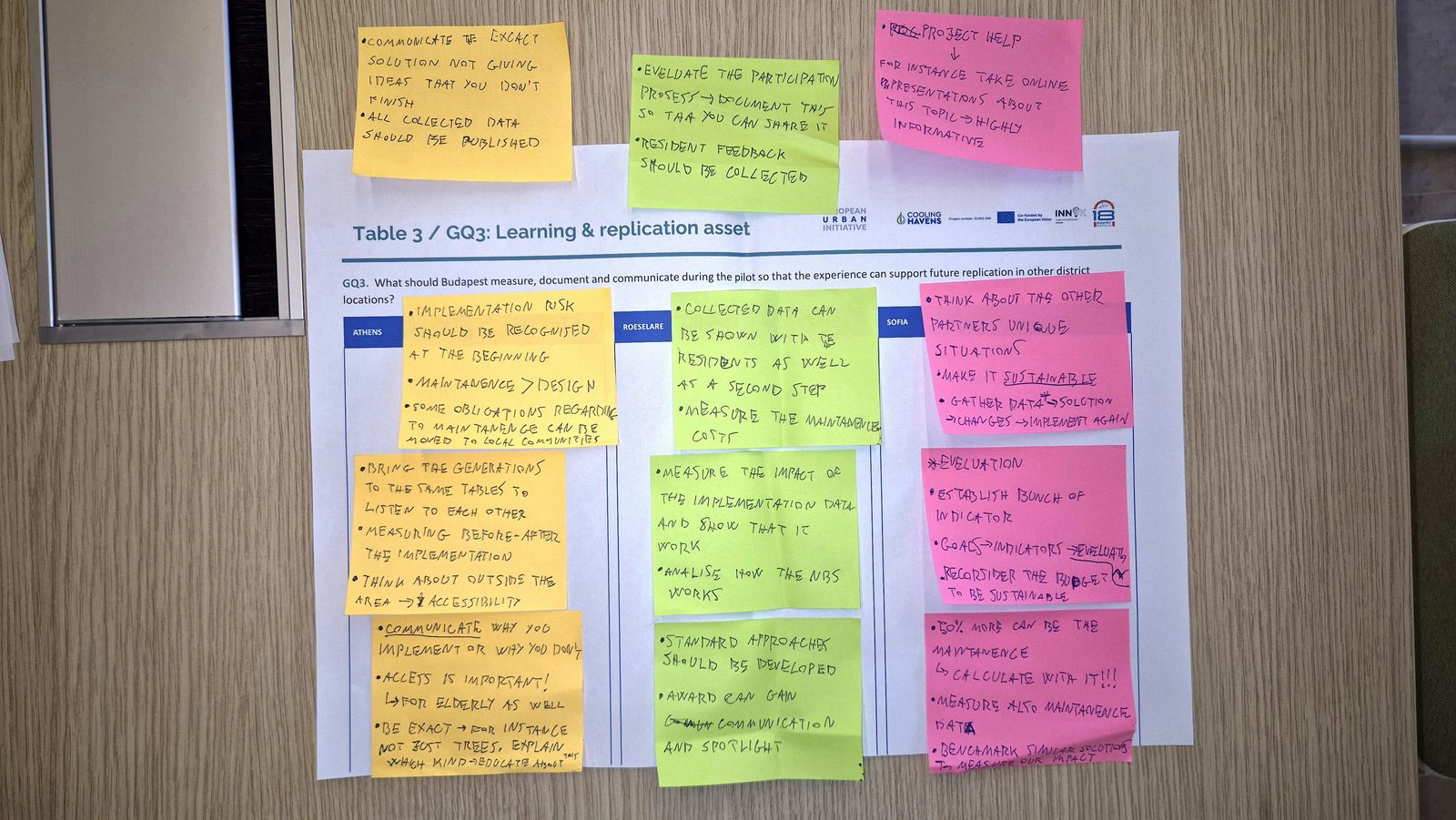
This last idea is especially relevant to Living Lab documentation. The professional value of experimentation does not lie only in showcasing successful solutions. Ideas that did not work, constraints, revised decisions and problems that arose during implementation are just as much part of the knowledge being created.
Bókay Garden: local knowledge is not an add-on but raw material for design
The international partners' visit to Budapest also gave District XVIII an opportunity to present its own participatory experience. László Rónavári-Kedves and Dr Gyula Nagy jointly presented the process behind the development of Bókay Garden.
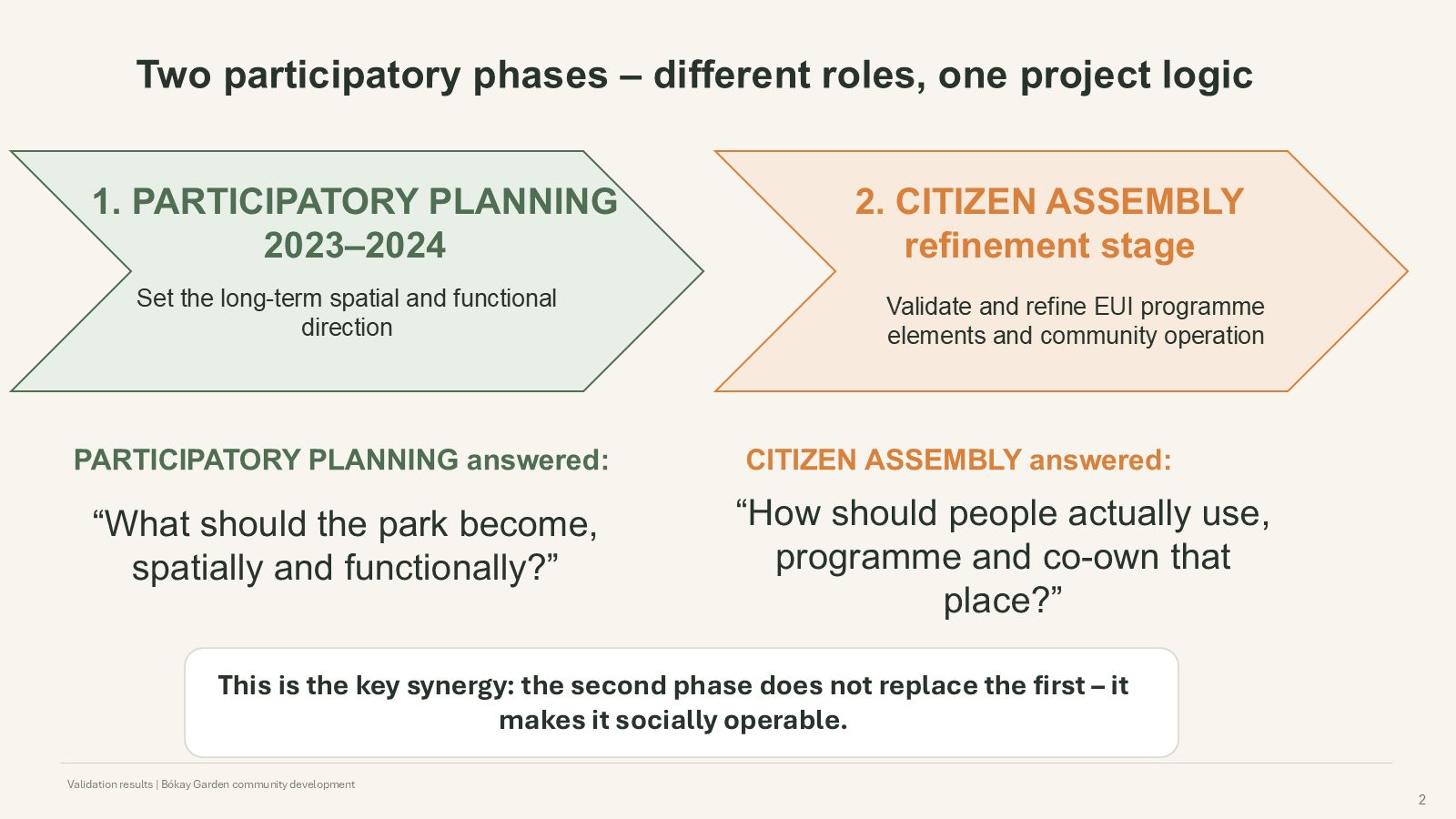
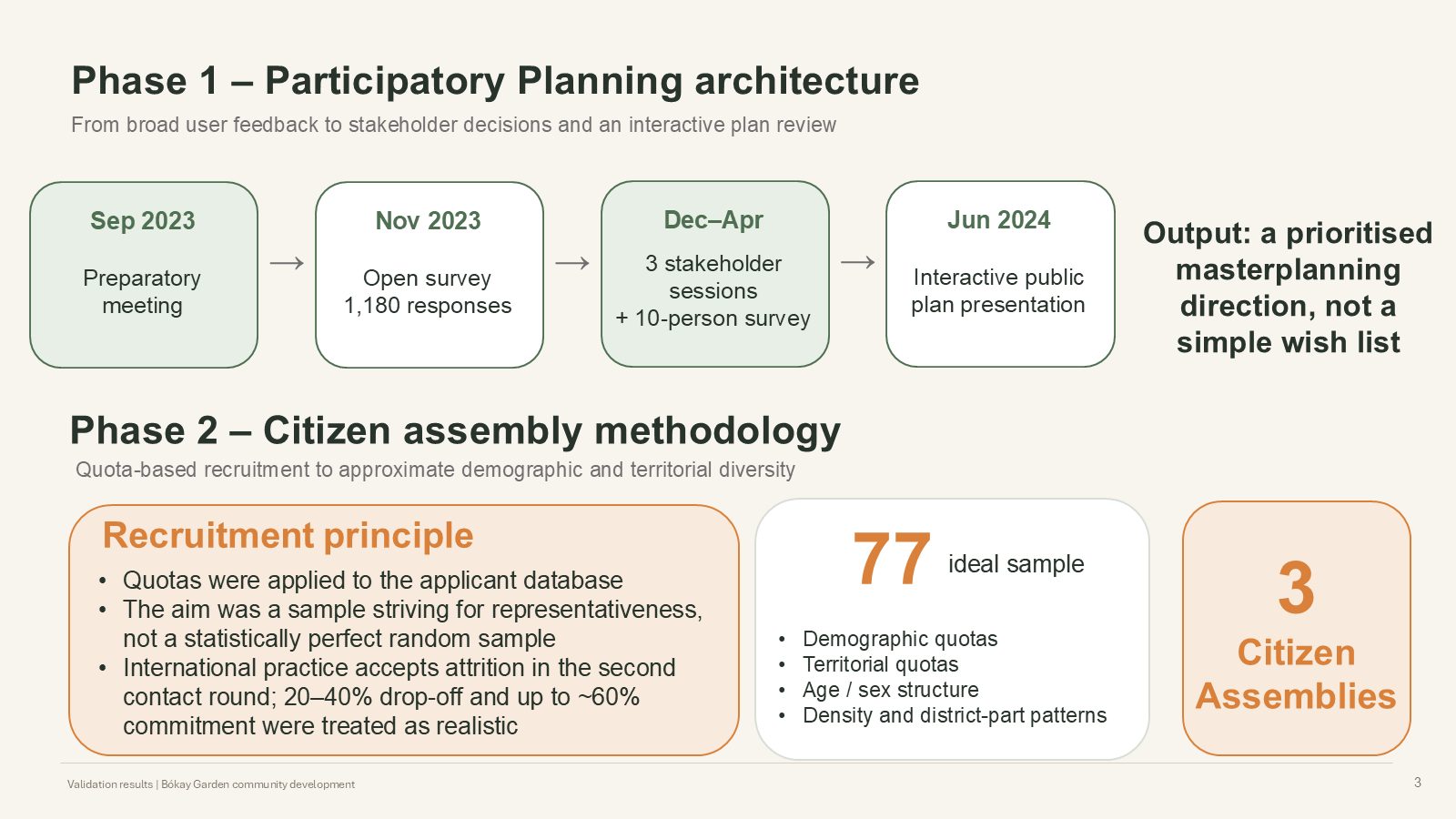
The methodology presented distinguishes between two successive participatory phases. The first was participatory planning to set the longer-term spatial and functional directions. The second, built around a citizens' assembly, looked at how people could use, programme and partly co-manage the space.
The process began in autumn 2023 with a preparatory meeting, followed by an open questionnaire that received 1,180 responses. This was followed by three stakeholder workshops and, finally, an interactive public design presentation. Participatory planning therefore did not operate as a simple wish list. User experience had to be gradually turned into design decisions.
The survey produced strong and consistent signals. A significant share of respondents wanted more park and leisure functions. Better integration of Turul Park and an inclusive playground also received strong support. Several hundred individual suggestions were submitted on green space, water, sports facilities, drinking fountains, toilets and other public-space services.
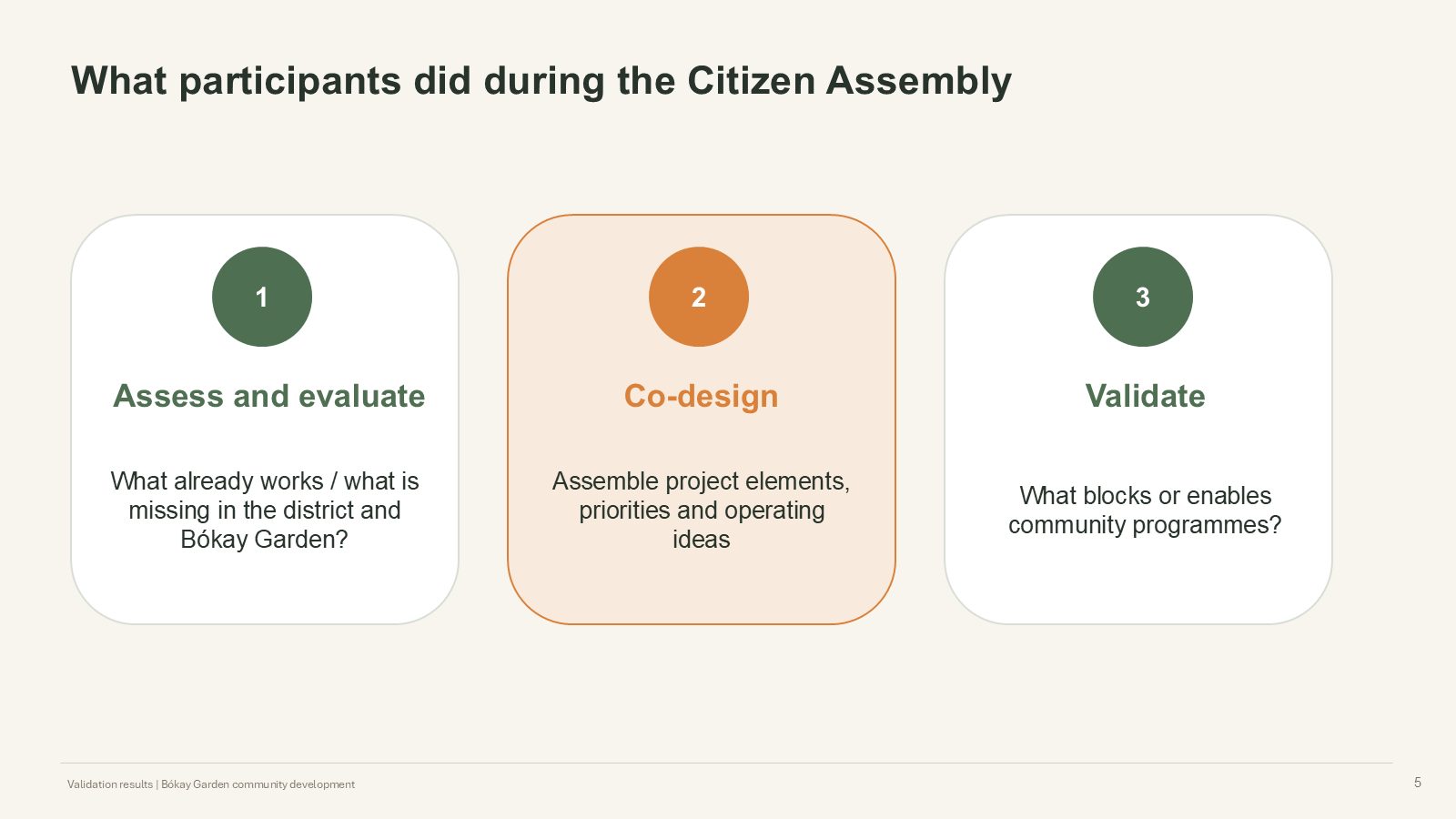
The later citizens' assembly, however, went further. Participants did not simply vote from a pre-prepared list. They combined functions, programmes and ideas for running the space, and then used these to assess individual elements of the project.
In the results, community and recreational functions received the strongest emphasis. The groups put together different concepts, but the common denominator was clear: they envisaged Bókay Garden as a year-round, nature-oriented, inclusive community and recreational hub for the district.
One of the key insights of the participatory process is that a good community space does not necessarily come alive through large events. Regular and easily accessible opportunities to meet, benches and tables, seating that faces each other, small-scale programmes, local information networks and recurring occasions can matter much more.
The citizens' assembly also brought to light operational details that are less visible in a conventional physical plan. Reaching young people, getting information to residents, involving civil society organisations, feedback mechanisms and addressing territorial inequalities all became issues that directly affect how a development works socially.
A methodological lesson from Bókay Garden that also applies to Havanna
Bókay Garden and the planned intervention on the Havanna estate are, of course, not the same project. The site, the functions and the immediate purpose of the investment are different. The participatory experience, however, reveals an important methodological connection.
A physical plan on its own does not describe how a public space will work. It can determine where planting, seating, paths, lighting or water features will go, but it cannot by itself create everyday use, local responsibility or social relationships.
For Havanna, then, one of the questions for the coming period will be how to link the technical pilot with an understanding of users' experience. Where is shade needed along everyday routes? Who uses the area at different times of day? Where do people feel safe? Which intervention do they understand and accept? What would residents really use, and what is innovative on paper but less relevant to everyday local life?
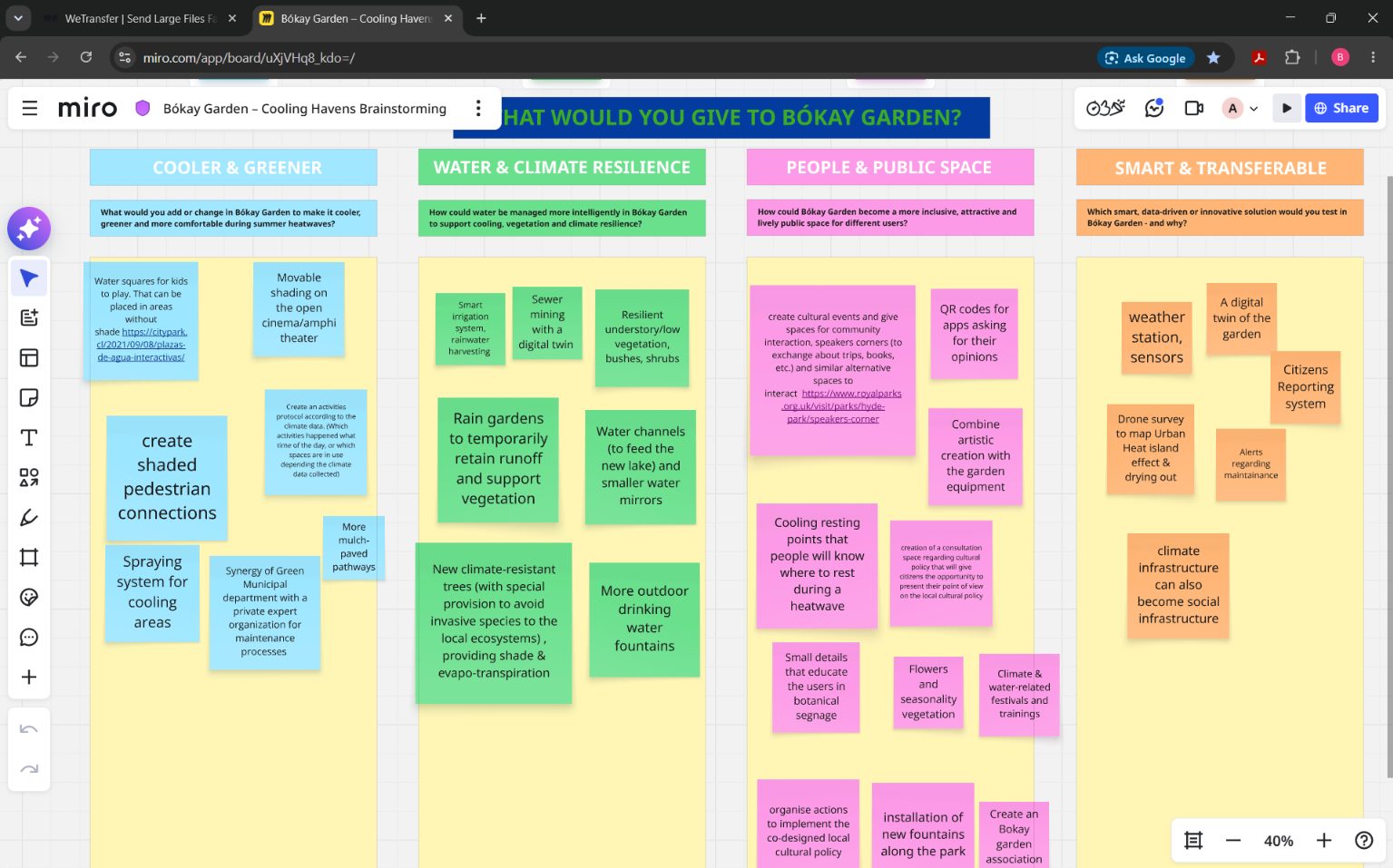
The brainstorming session on Bókay Garden broadened this thinking further. The ideas were grouped around four themes. Under a cooler and greener environment came movable shading, shaded pedestrian links and water to aid cooling. Water and climate resilience covered smart irrigation, rainwater harvesting, rain gardens, water channels and climate-resilient planting. Community space brought up cultural programmes, resting points, spaces for participation and local initiatives. And smart and transferable solutions included a weather station, sensors, a digital model, resident fault reporting and maintenance notifications.
The diversity of the list is instructive in itself. Beyond a certain point, climate adaptation can no longer be separated from the social quality of public space.
Data alone is not yet knowledge
One of the strongest shared themes of the Budapest visit was data collection. Several working groups ranked environmental monitoring first, and the partners' experience also confirmed that without measurement it is difficult to judge the actual impact of an intervention.
At the same time, it is important for the project to distinguish between data and knowledge.
A sensor can show soil moisture. A thermometer can track changes in temperature. A weather station can record rainfall and air conditions. But these only support decision-making if it is clear, before installation, what question we are trying to answer.
Do we want to know whether surface temperature has fallen? Or whether people's perceived heat has improved? Perhaps whether less irrigation water was needed? Are we looking at whether more people use the space? Or whether the planting survives extreme summer periods?
These are different questions, and they call for different measurement methods.
When designing the monitoring system, therefore, there may be room for social observation alongside technical parameters. Usage counts, short questionnaires, field observations, interviews and resident feedback can complement the sensor data.
In this way, what a thermometer cannot see can also become measurable. Whether people stay longer in the space. Whether use has changed at different times of day. Whether more age groups appear. Whether people feel the place is safer. Whether they understand how the new system works. Whether they are willing to take part in looking after it.
The next stage of joint learning is the feasibility study
The September visit did not settle the professional questions about Havanna. On the contrary, it made them sharper.
The task now is no longer to decide in general whether shading, planting, smart irrigation or monitoring are good. The question is which of these will work in this particular place, in what combination, under what operating conditions and at what cost.
The soil and utilities need to be understood. The condition of existing trees must be assessed. Pedestrian movement, parking and access need to be surveyed. Possible water sources must be identified. Decisions are needed on sensor locations and data management. Responsibility for maintenance must be clarified. And throughout, there must be a constant feedback loop with local users.
This process may be slower than choosing an off-the-shelf technology. But it is precisely this that can make the investment meaningful from a local point of view.
For the Living Lab, one of the most important tasks in the coming period will be documenting this decision-making process. That way the focus can fall not only on the solution finally chosen but also on the path leading to it. What alternatives came up. What data our decisions were based on. Why an idea had to be modified. What compromises were made. How users responded. What the measurements showed.
This is what will later add up to knowledge that is genuinely transferable.
Transfer succeeds when the local questions change too
Perhaps the most important lesson of the Cooling Havens visit to Budapest is that international knowledge transfer is not a one-way process.
Athens offers experience in linking heat, water and green infrastructure. Roeselare shows how participation can lead to more ambitious climate adaptation interventions, and why integrated thinking is needed from the outset. Sofia gives an example of how a cooling place can also become a community space, and why it is vital to clarify maintenance in advance. And Budapest brings experience from its own participatory processes of how residents' views can be turned into knowledge for design and operation.
These experiences meet on the Havanna estate.
The next question is no longer which city's solution should be adopted. It is rather what local combination can be put together from these different experiences.
The first step in the process may not be a striking architectural intervention, but measurement. A utilities survey or consultation with residents may be needed before any technological element. For a planned planting scheme, maintenance capacity may prove to be the most important constraint. And it may also turn out that a smaller, precisely measurable experiment yields more knowledge for the next decision than a large package delivered all at once.
For the Living Lab, it is precisely this process that gives the project its professional value.
The goal is not to have a ready answer to every question in advance. The goal is for the right questions to lead to verifiable decisions, for decisions to lead to solutions that can be tested, and for testing to produce knowledge that can be shared.
In this sense, the Budapest site visit was not a three-day event but an important milestone in a longer learning process.
On the Havanna estate, the stage is now beginning in which international experience has to become local evidence.
Photo gallery from the workshop
Image gallery
Related materials
Background materials to download
Would you like to work with us?
Research, methodological support and solutions tested in real-world settings – for local authorities, institutions and researchers.